
Why You Should Be Careful Following Tips From SAT Gurus on Social Media


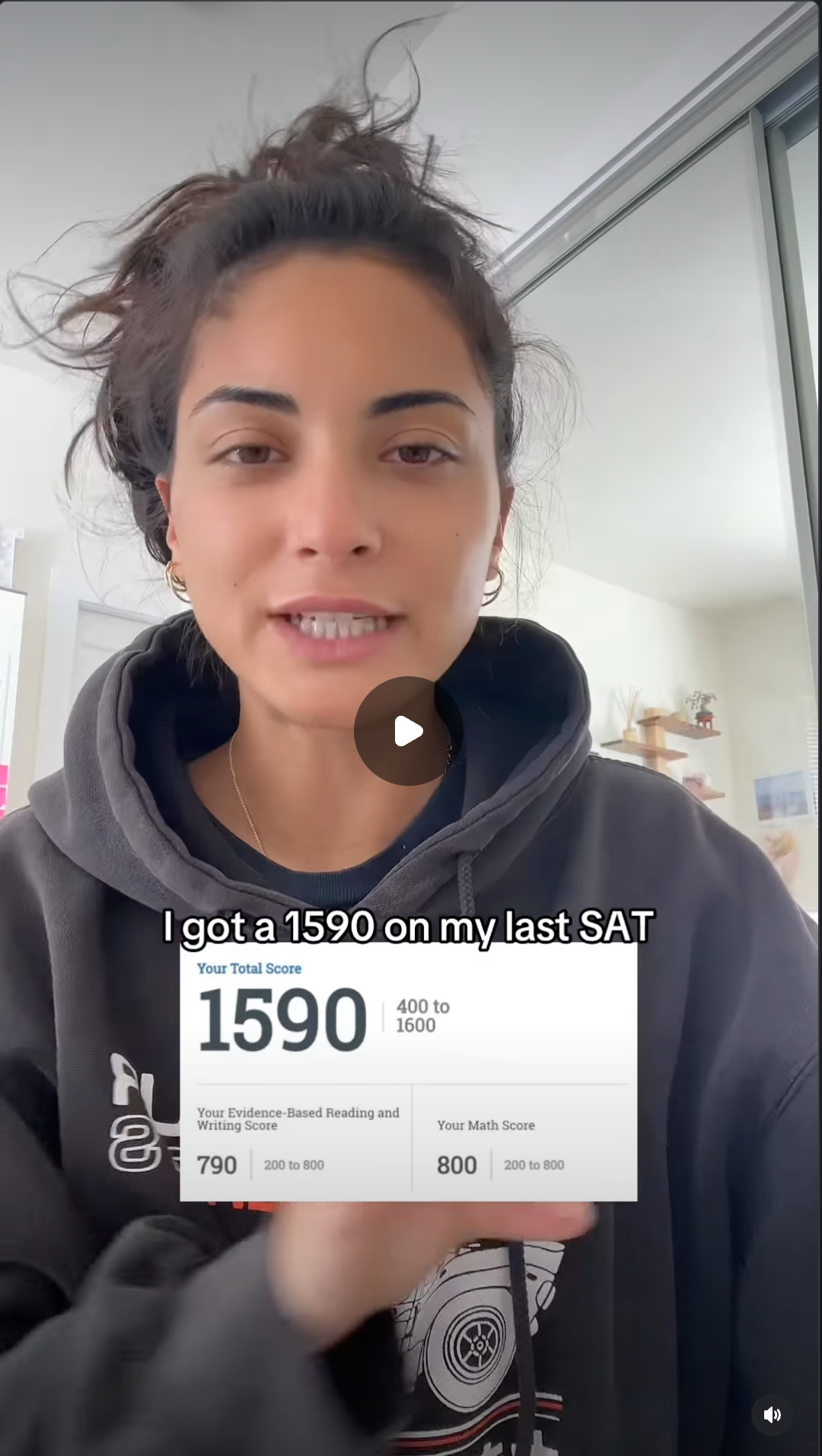
I'm terrible with social media. I can't hide it. I'm old and boring, and I only do blogs. But like everyone, I admit that I do scroll. In fact, I wish I scrolled a lot less than I do. Why? I get frustrated every time I do, because my feed is inundated with a thousand SAT "gurus" telling everyone the same thing: do this one thing every time and you'll never miss these questions again. It sounds great doesn't it? They flash an image of a 1590 (from two years ago if you slow down and look at the date on the image), then authoritatively tell you how they purportedly got that score.
But, here's the trouble.
Most of that advice isn't wrong because the person giving it is deliberately trying to mislead you. It's wrong because it's incomplete, and on a test built the way the SAT is built, incomplete advice is exactly where points disappear. A tip that works most of the time feels reliable right up until the moment it costs you — and it tends to cost you on the questions that separate a good score from a great one.
It's no wonder why students come back surprised that they missed grammar questions they felt "confident" about.
I admit these "hacks" are successful for the fly-by-night test prep services behind them. I hand it to them. Whoever is behind these "influencer marketing campaigns" is doing a great job duping thousands into likes, reposts, and comments. I wish I could garner a fraction of the likes they get for my own content.
But, alas, the truth isn't always popular.
Why "Always" and "Never" Rules Fall Apart
The digital SAT is adaptive, and it's written by people whose entire job is to know what students have memorized. They have a whole team of psychometricians and psychologists who know what students are inclined to think and do. That's the part the shortcut videos never mention. Any "hack" that begins with always or never is a rule the test writers already assume you're carrying into the test with you — and they write questions specifically to catch you in your own "rule."
Think about what that means. If a trick works on 70% of the questions it applies to, it will feel dependable every time you practice it. But the SAT isn't trying to test the 70%. Those questions get minimal points because they know it's an "easy" question. The questions that place you in one score band versus the next are frequently the ones designed to punish pattern-matching. The shortcut doesn't just fail you there by accident. It fails you there by design.
So, while doom scrolling on insta this week, I found three terrible "rules" that will cost you dearly. These three myths below all share the same flaw. Each one replaces metacognitive strategies with spot the pattern strategies — and the SAT is very, very good at making that reductive swap very expensive for you.
Myth 1: "If You See a Semicolon and a Period, Eliminate Both"
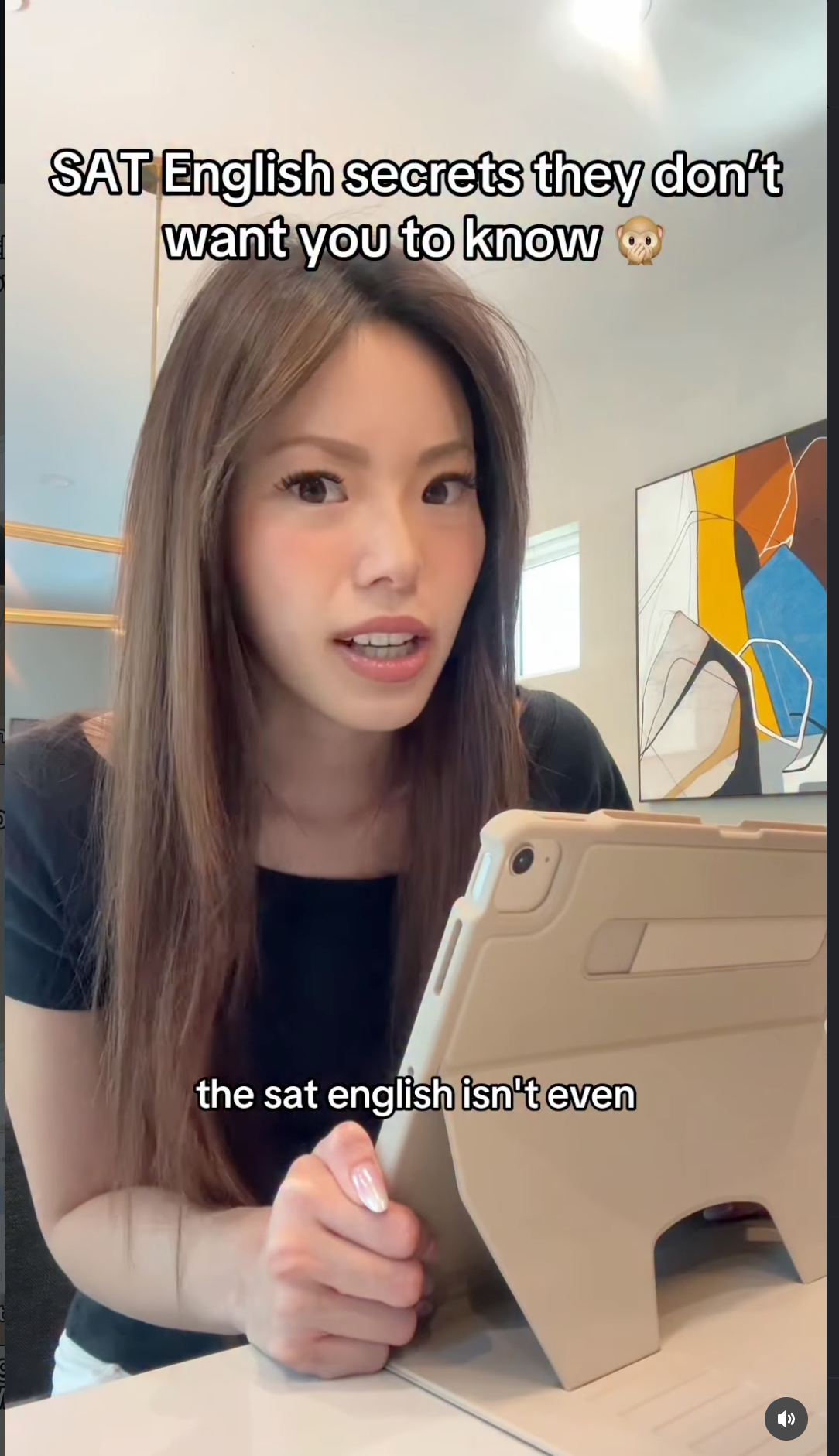
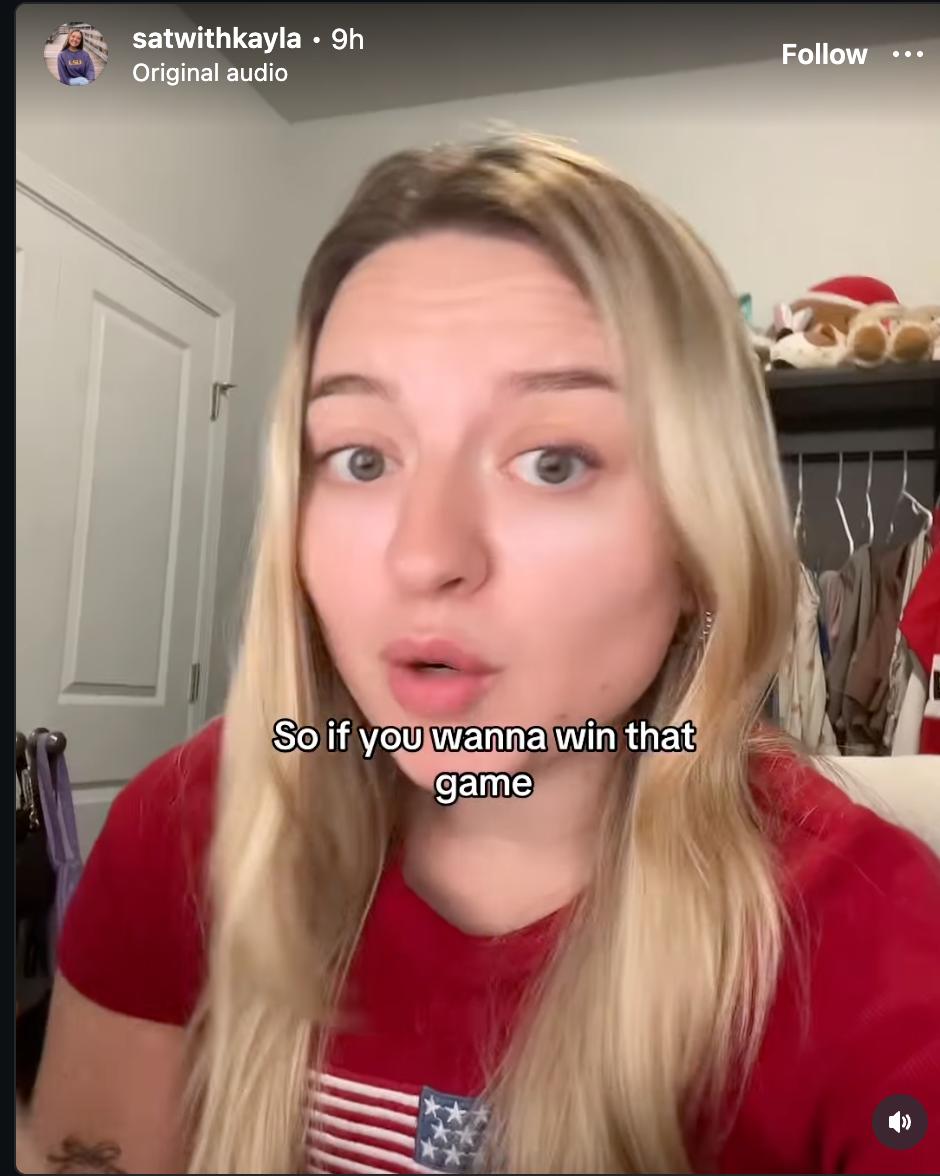
This one circulates constantly, and I understand why it survives. On a lot of boundary-punctuation questions, a semicolon and a period really are functionally identical — both create a full stop between two independent clauses. When two answer choices do the exact same grammatical thing, neither can be the single correct answer, so eliminating both actually scores the point. This SAT guru here is regurgitating it online with 1000s of likes, unfortunately.
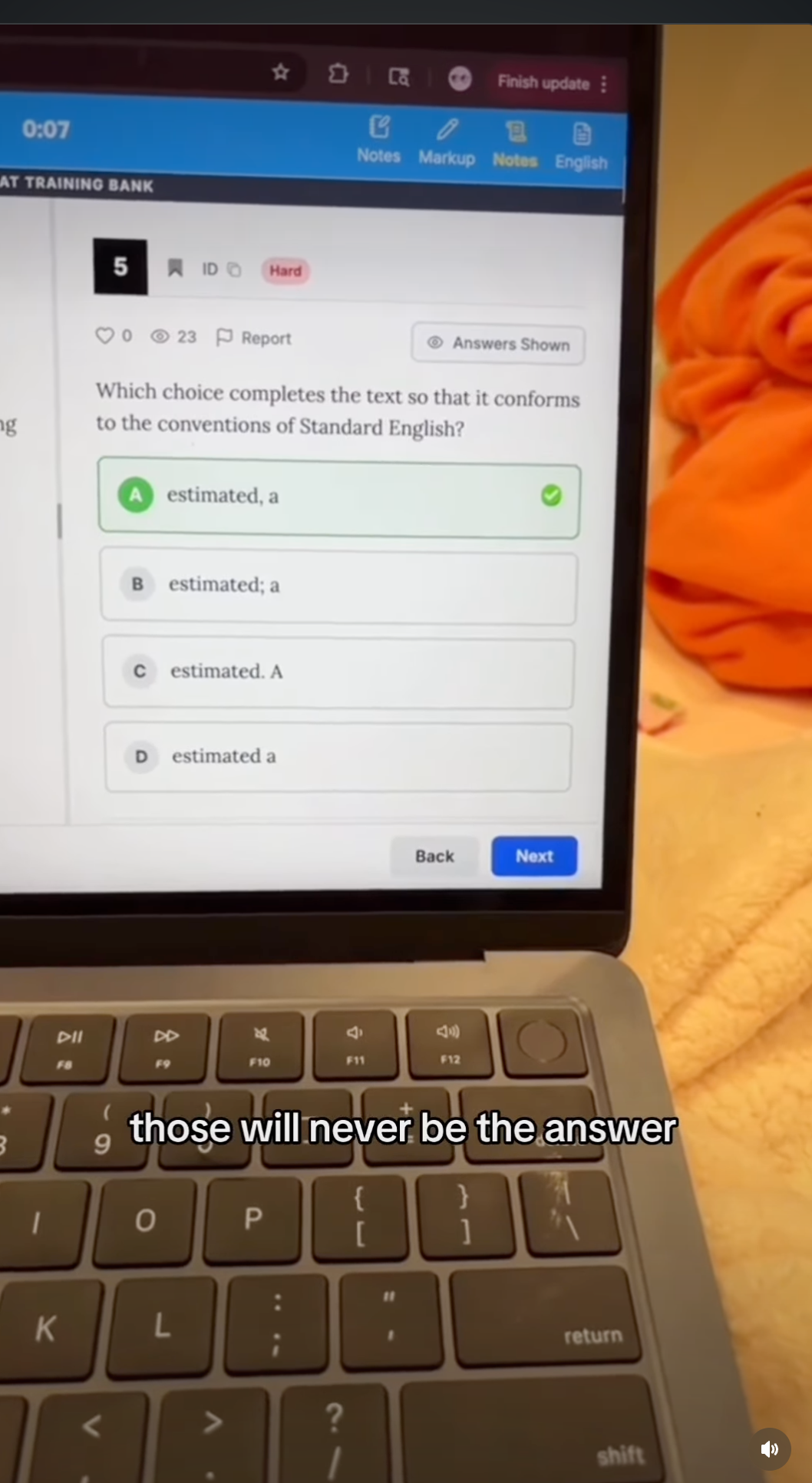
The problem is that the rule teaches you to skip at least two options that could be at play here:
- The semicolon could be part of a complex list
- Believe it or not, the period could be the option here, if there are two independent clauses that need a hard stop right before a complex list.
These may seem like rare exceptions, but I have seen them used, time and time again, on the official SAT.
Example 1:
Give this one a try and tell me if "those will never be the answer" is true for the semicolon and period.
Example 2:
The rarest of the rare. Most tutors don't even know about this one, so I'm loath (reluctant) to even share it, but here it is. This one comes straight from the "very hard" punctuation drills on the Gauntlet:
There you have it, social media SAT grammar hack #1 debunked.
Myth 2: "Three Answers Are Plural, One Is Singular — Pick the Singular"
On a straightforward subject-verb agreement question, this works like magic. It's true that for most subject-verb agreement questions the "odd one out" will be the correct option.
The test gives you a singular subject, three plural verb forms, and one singular verb form, and counting them usually gets you the answer. It works, and because it works on the easy ones, it feels like a hard and fast rule.
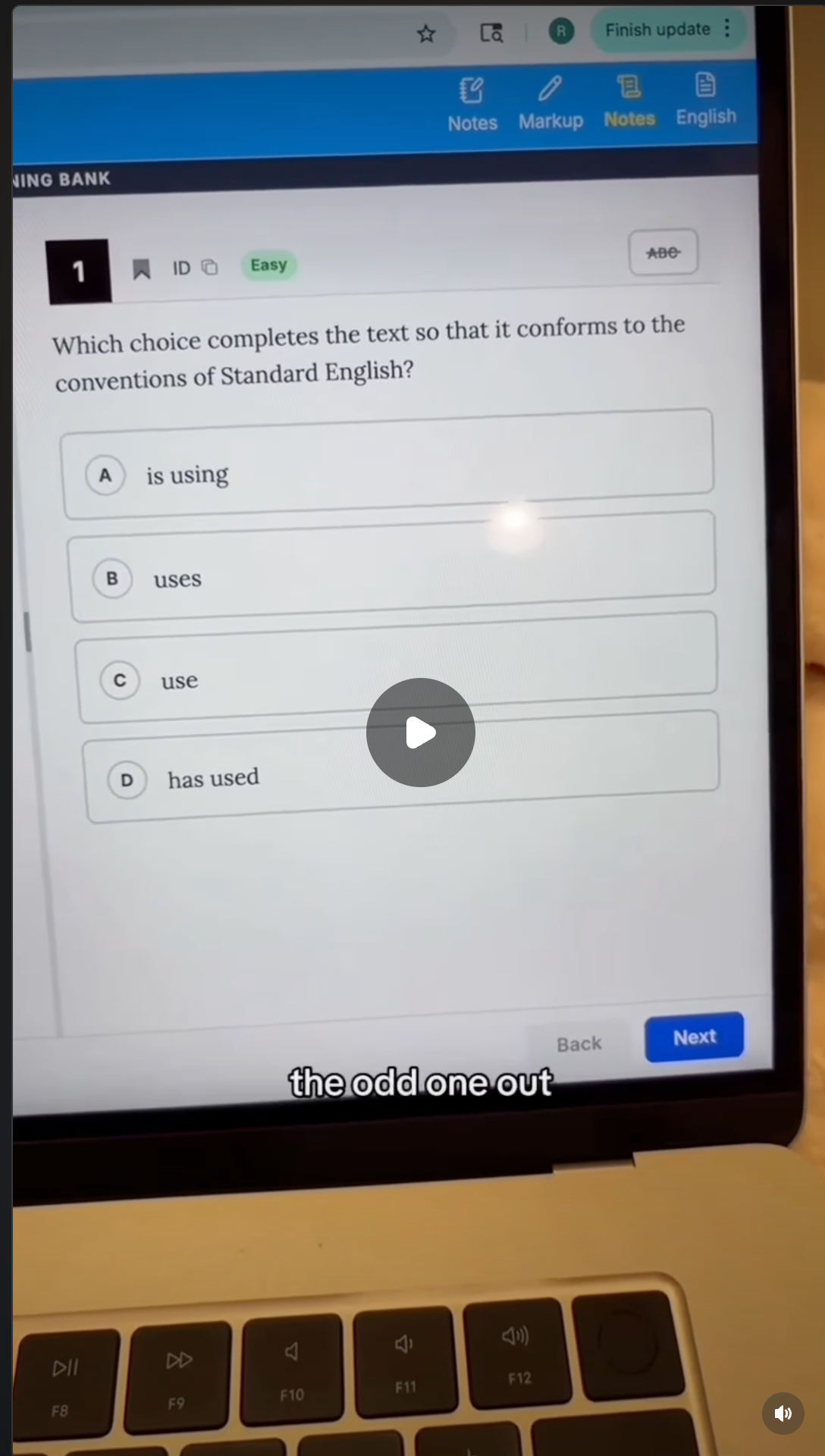
Then the test hands you a verb question that might not be about agreement at all — and the counting trick doesn't just get harder, it becomes meaningless.
Picture a question where the answer choices aren't four conjugated verbs but a mix: an infinitive, a participle, and two finite verbs. Now there's not much to count. The question is asking whether the sentence even has a main verb yet, whether a clause is complete or a fragment, and whether this particular spot calls for a finite verb or a non-finite one. "Which one is singular" isn't a hard version of that question. It's a different question, and the shortcut you learned on instagram doesn't work anymore.
The reliable skill isn't tallying the choices. It's recognizing what grammatical job the blank needs done, and only then deciding what form fits.
Example 1:
In this instance, the odd one out does happen to work, but it's not because it was singular. There are instances where this requires careful understand of the tense needed, or the rules for finite and non-finite verbs.
Myth 3: "If You See a Person's Name, There's No Punctuation Needed."
This is the most subtle of the three because it's right often enough to feel like a rule you can bank on. Plenty of questions use a name as a simple subject that flows straight into its verb with nothing in between, and in those cases "no punctuation" is definitely the correct choice.
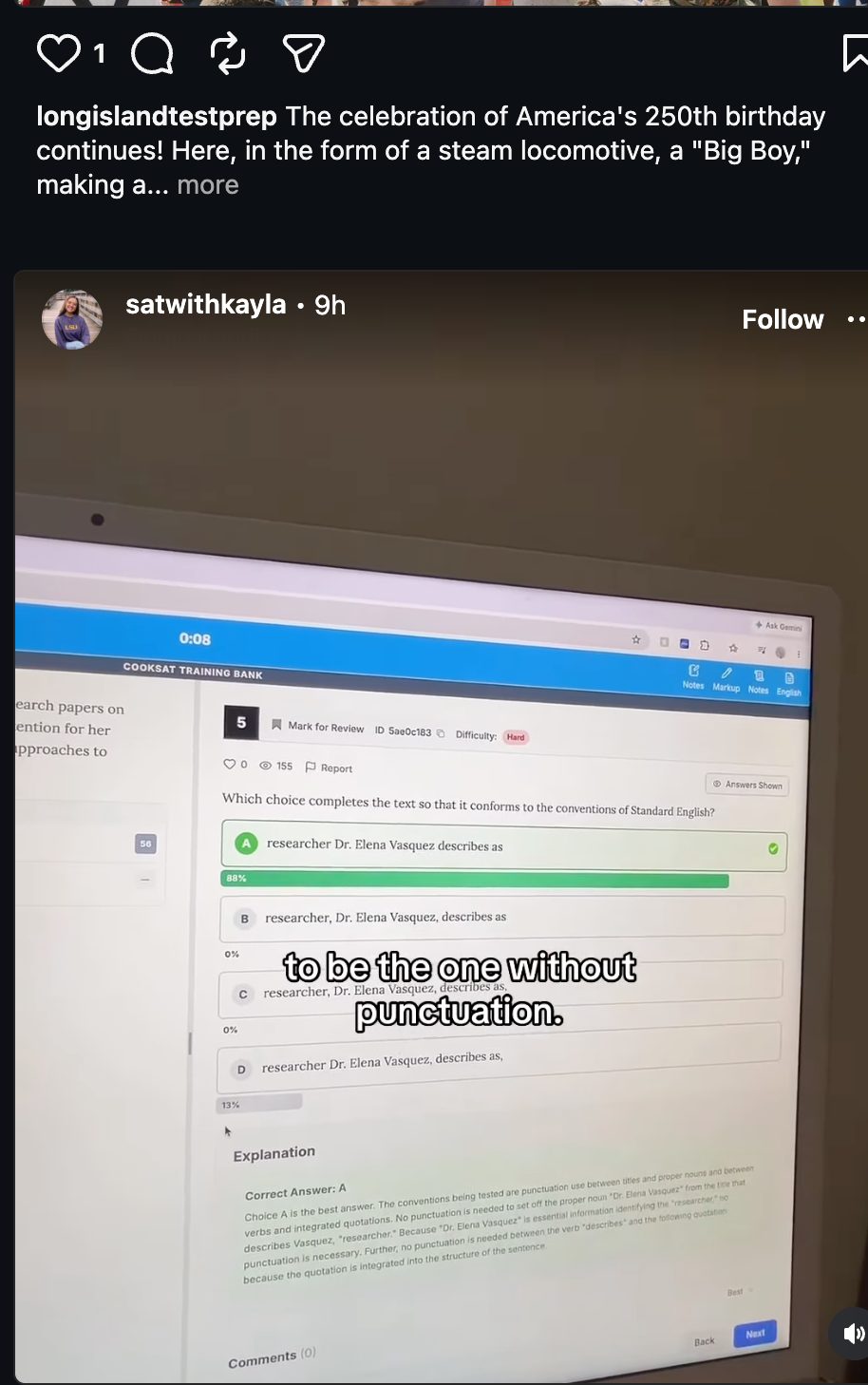
But the rule treats the name as the trigger, when the real question — every single time — is what grammatical role the name is playing in that specific sentence. And names can play a lot of roles.
When a name is a nonrestrictive appositive — extra information set off from the sentence — it needs punctuation on both sides. It's very rare, but if a unique title like the "cryptanalyst" below is mentioned before the sentence in play, then the name of the cryptanalyst isn't necessary.
Example 1:
Example 2:
Here's another example where "no commas" would cost you 10, 20, perhaps even 30 points in the grammar section of module 2:
Students who think "no commas" is a hard and fast rule may miss the fact that the nonrestrictive "who" clause is not necessary in many cases. Sure, the name is needed here, but the clause isn't.
Example 3:
What about titles and names inside interruptors?
Just one last example of how a hard and fast "rule" would get you in trouble here.
Some of my favorite Guru outtakes...
Every so often, if you pause the lightning fast reels, you'll notice some pretty silly things. Here are some of my favorites as of late:
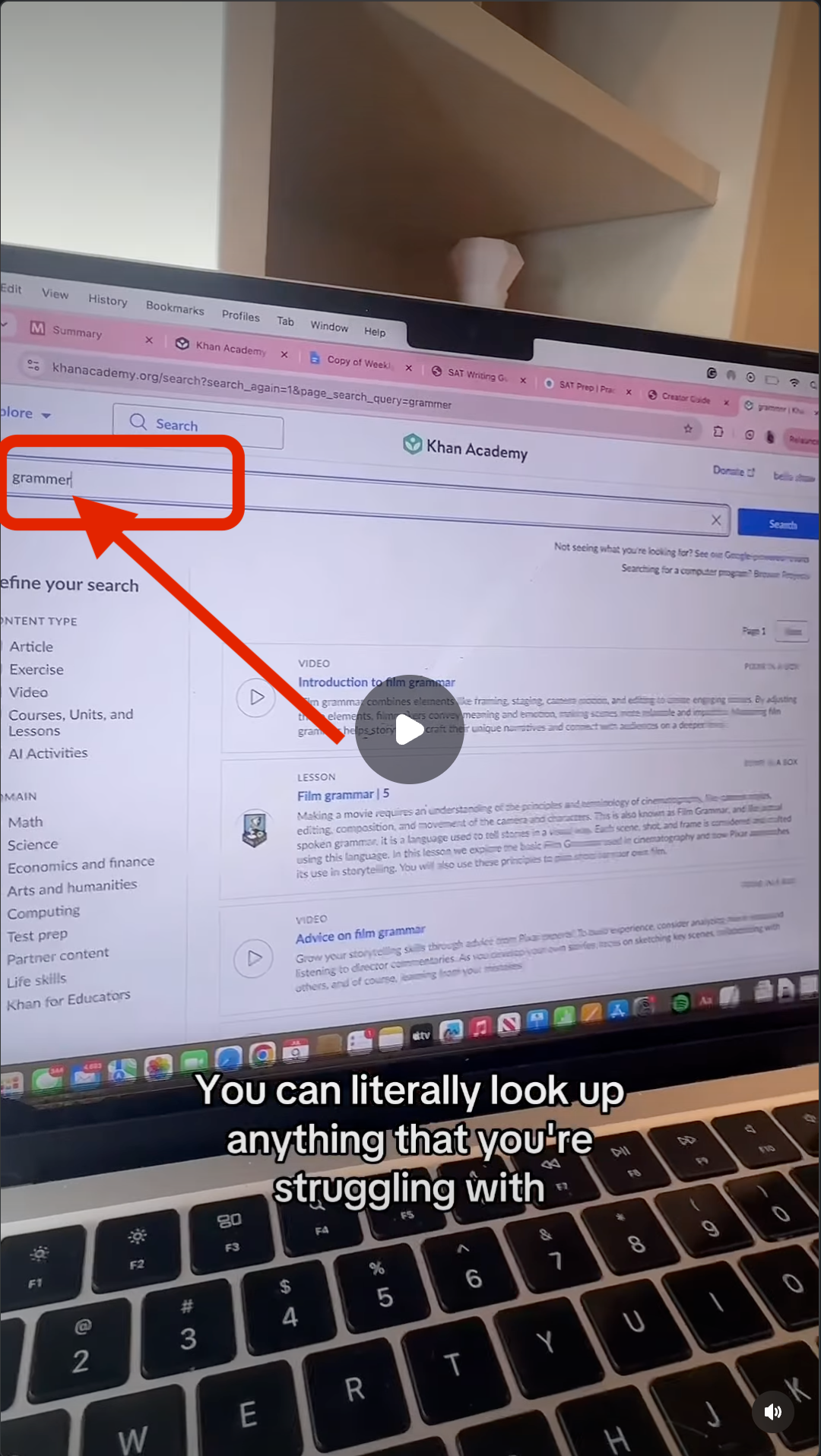
- The misspelled "grammer" when promoting Khan Academy. I admit, I make spelling mistakes, too, every once in a while, so I commiserate with this SAT guru.
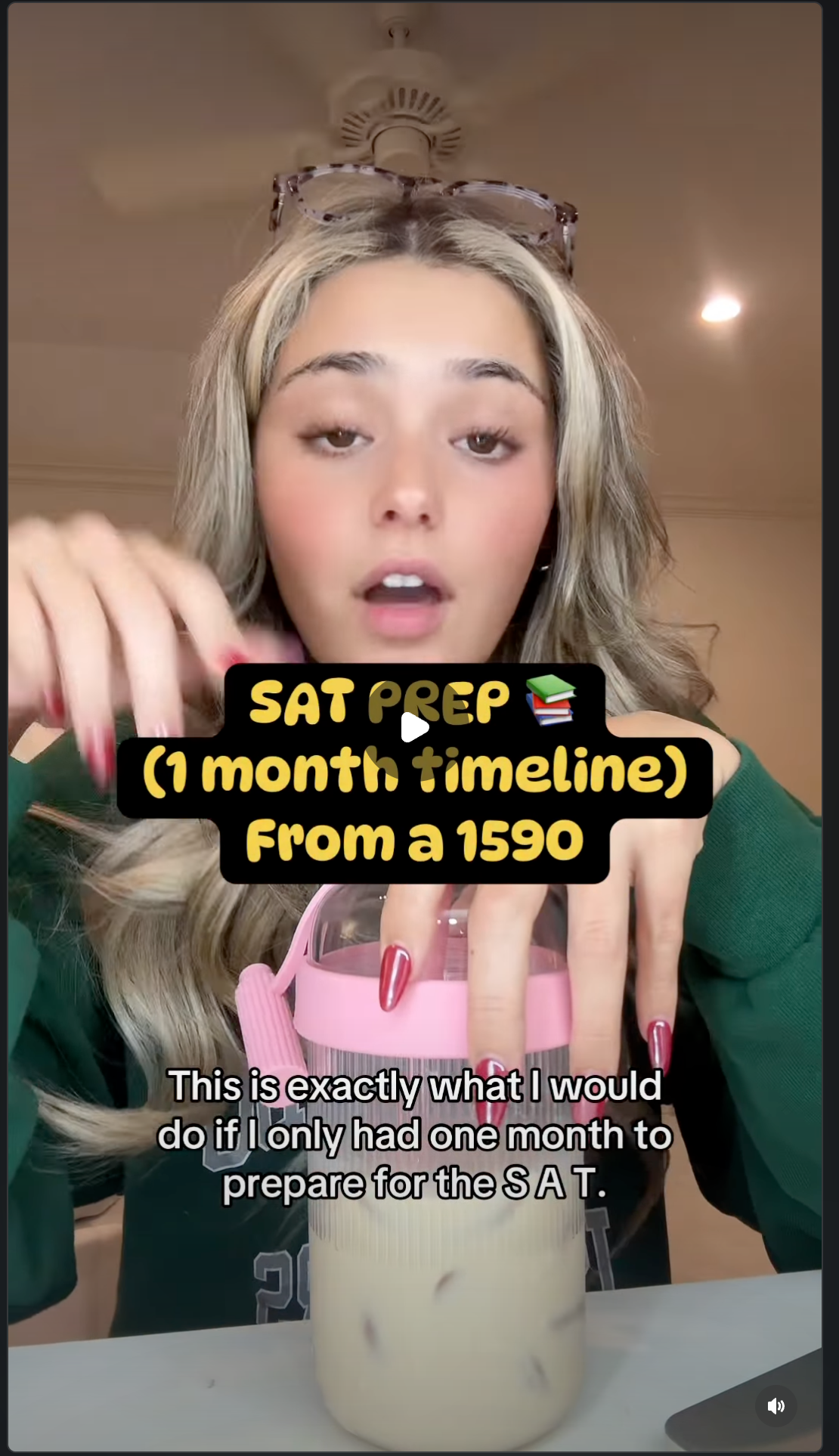
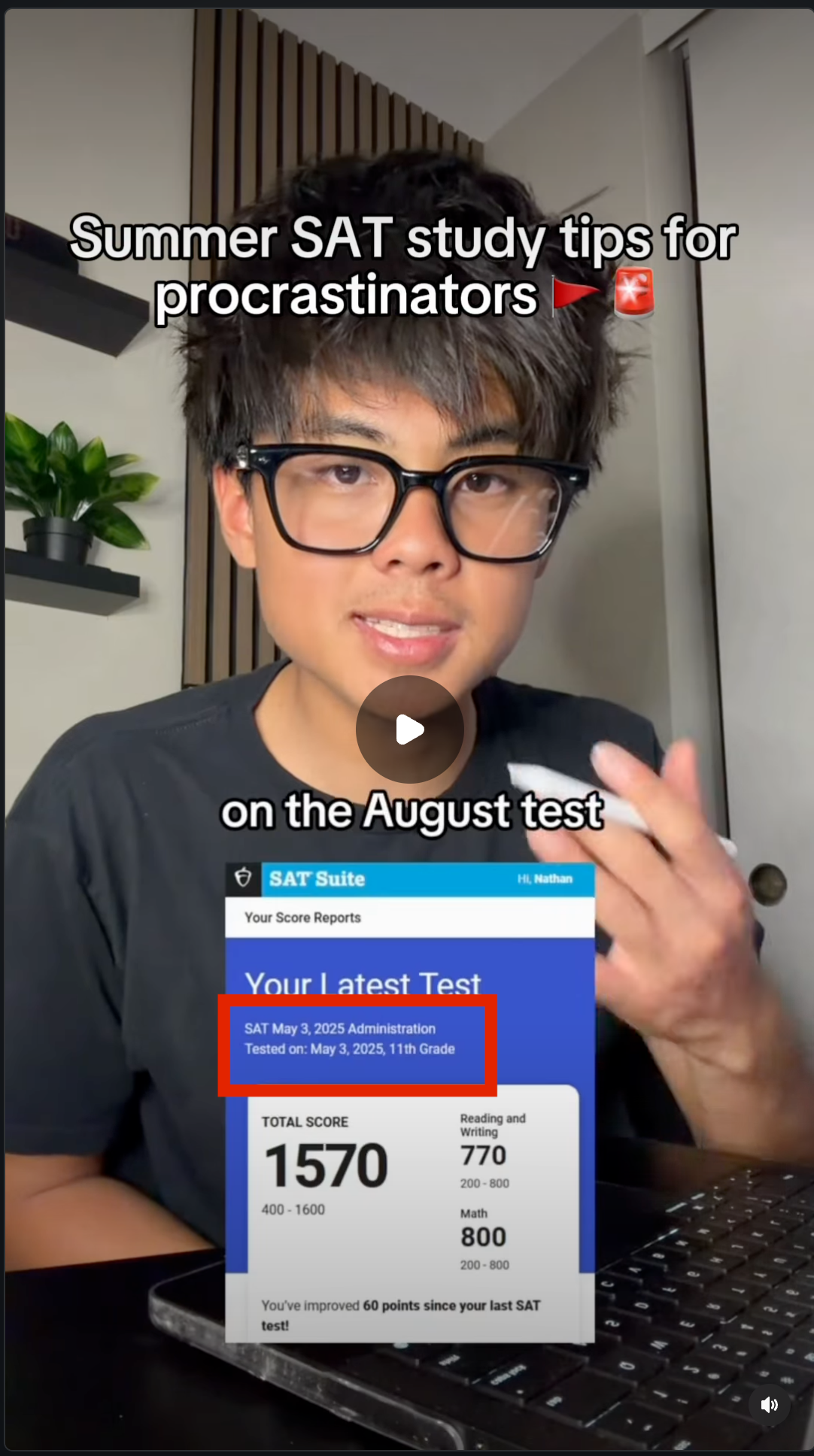
- Here is one guru discussing how he got a 1570 on the August SAT, yet the screenshot of his 1570 came from May 2025. I hope it was actually his.
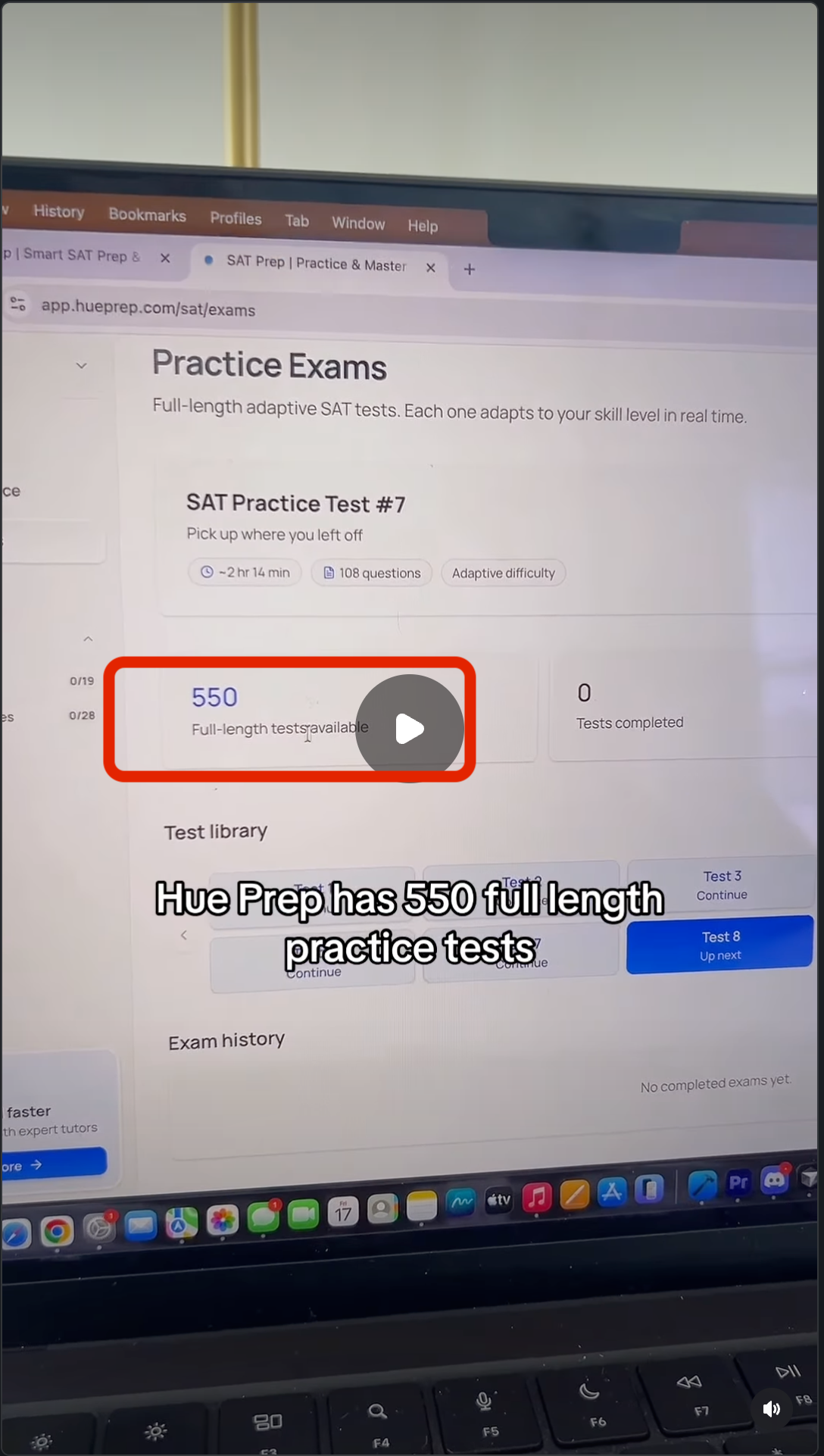
- Here is another screenshot of someone promoting an SAT prep site with 550 full-length SATs!!! 😱
Can you imagine?? Who wrote these?
If you're working with a site that has 10,000+ questions and 20+ tests (let alone 550!!!), chances are they aren't very high quality. I think we both know who (what) writes these questions.
What Reliable Prep Actually Looks Like
Notice what all three myths have in common. Every one of them replaces understanding and competency with a blind reflex, which will fail you when it matters most.
The College Board SAT test writers are smarter than the average bear. Trust me.
Reliable prep runs in the opposite direction. It teaches the underlying grammar and the reasoning behind it, so that when you see a question you've never seen before you have a method instead of a memorized guess. That's the entire idea behind how I teach: frameworks like SPOT, ISEE, and PROVE-IT exist so you're diagnosing what a question is really asking, not sifting through a stack of tricks hoping one fits. Skill-mapped practice exists so that when you miss something, you know why, and you know exactly what to work on next.
None of that is as satisfying as a fifteen-second hack. It's slower, and it asks more of you. It also happens to be the thing that will benefit you long after you take the SAT.
How to Vet SAT Advice You Find Online
You don't have to swear off SAT content on social media. You do have to run it through a filter. Before you trust a tip, ask:
Does it explain why, or only what? A tip that tells you what to pick but never why is a tip that will strand you the moment the question changes.
Does it say "always" or "never," or does it teach you to read the sentence? Absolute rules are the ones the test writers are counting on you to memorize. (Funny how this mirrors our Extreme Words pattern in PROVE-IT. If you're one of my students, you know what I'm talking about.)
Is the person credentialed, and do they show their work? Anyone can film a confident fifteen-second reel. Far fewer can walk you through a hard question and defend every step.
Would it survive a genuinely difficult version of the question? If you can imagine one hard example where the rule falls apart, the rule isn't a rule. It's gambling, at best.
That's the whole idea behind how I teach at Mr. John's Test Prep, and it's what The Gauntlet is built to do. Every question in it is written by a human being who knows the test, organized by skill, so when a student misses something, they see exactly which skill to work on next — no unreliable hacks or gimmicks, just the specific thing standing between them and the next score band.
Mr. John
Mr. John's Test Prep