Tomorrow Is the August 22nd SAT Test Day: What to Remember


Dear MJTP family,
Tomorrow morning, at least forty of you who have worked with me this summer sit for the August SAT. I'll be sitting for it too, in a room somewhere in Florida, working the same modules you are.
None of what follows is a prediction. I don't do predictions. Yet, these are the patterns we've worked on all summer. Be mindful of them tonight and tomorrow.
1. Every correct answer is a restatement of explicit evidence
This is the foundation we cover in every introductory lesson, and it holds even on the inference questions. The College Board does not ask you to be clever and it doesn't care about your opinion. Actually, it loves for you to be opinionated.
Want to know why?
The more opinionated you are, the less robotic you are, the more questions you'll fight to "make sense of." The CB loves this because it keeps its SAT verbal average low.
If the passage says the "difference increased" and an answer choice says there was an "increase in disparity," you know you're on the right track. That's the same idea wearing a different word. Trust that.
But here's the part that costs students points: a verbatim buzzword from the passage does not always make an answer correct. That's exactly where they hide the shenanigan. They'll lift a phrase straight out of an important piece of the text, wrap it in a claim the passage never made or add an "extreme" word, and wait for you to grab it because it looked familiar. Match the whole answer against the evidence, not just the piece that jumped out at you. Partial truths are still wrong answers.
2. Eliminate with your PROVE-IT categories, not with your interpretation
When you're down to two, don't ask yourself which one sounds better. Name the flaw. Run through the categories. An answer is wrong for a reason you can point to, and if you can't point to it, you're not eliminating — you're guessing with extra steps.
The moment you start explaining to yourself why an answer could work if you read the passage a certain way, stop. You've left the text. Interpretation is how you talk yourself into a trap.
3. Watch the "complete the assertion" chart questions
Some Command of Evidence questions with a chart or graph don't ask you to support or weaken anything. There's no claim in play. The prompt just asks you to complete a statement, and three of the four choices are wrong because they misread the chart itself.
This is where you check the axis labels and the units before you check anything else. If the chart defines "percentage of forms," then an answer that talks about "average payment" is dead on arrival. It doesn't matter how sensible it sounds. The data doesn't exist on that chart. Eliminate it and move on.
These questions are fast points once you stop reading them as logic questions and start reading them as chart-literacy questions. Those of you who worked with me this summer know exactly what I'm talking about. Hint: IRS
4. Not every semicolon and period can be eliminated on sight
You've built the habit of spotting a semicolon and a period as functionally identical, and that habit is correct — most of the time. But they know you have that habit. This is exactly why I debunked this "SAT social media hack."
Go check out that post.
Read what's actually on either side of the punctuation. Check for complex lists. Slow down for one extra beat on those.
5. One main verb per clause
When you see an -ing form, or either of the other two non-finite forms, ask the same question every time: where is the subject and does this clause already have a finite main verb?
If it does, the -ing form isn't competing for that job. It's doing something else — modifying, describing, or acting as a noun.
6. Simple vocabulary in Module 2 is a warning sign
Early in the second module, before the questions get hard, you'll sometimes see a Words in Context question where every answer choice is a word you've known since eighth grade. That should make you suspicious, not comfortable.
If the choices look easy, the shenanigan could be in the passage. Go back and find the part you skimmed. Usually there's a qualifier, a contrast, or a negation you read past.
And know these:
- imparts — gives, conveys, passes along
- itemize — to list out individually, piece by piece
- salient — most noticeable, standing out
- sanguine — optimistic, cheerfully confident
- harbingers — signs of what's coming, forerunners
- attenuates — weakens, reduces in force
7. Expect phrasal transitions
Transition questions are getting longer. You'll see fewer one-word answers like "however" and "therefore," and more multi-word phrases doing the same work.
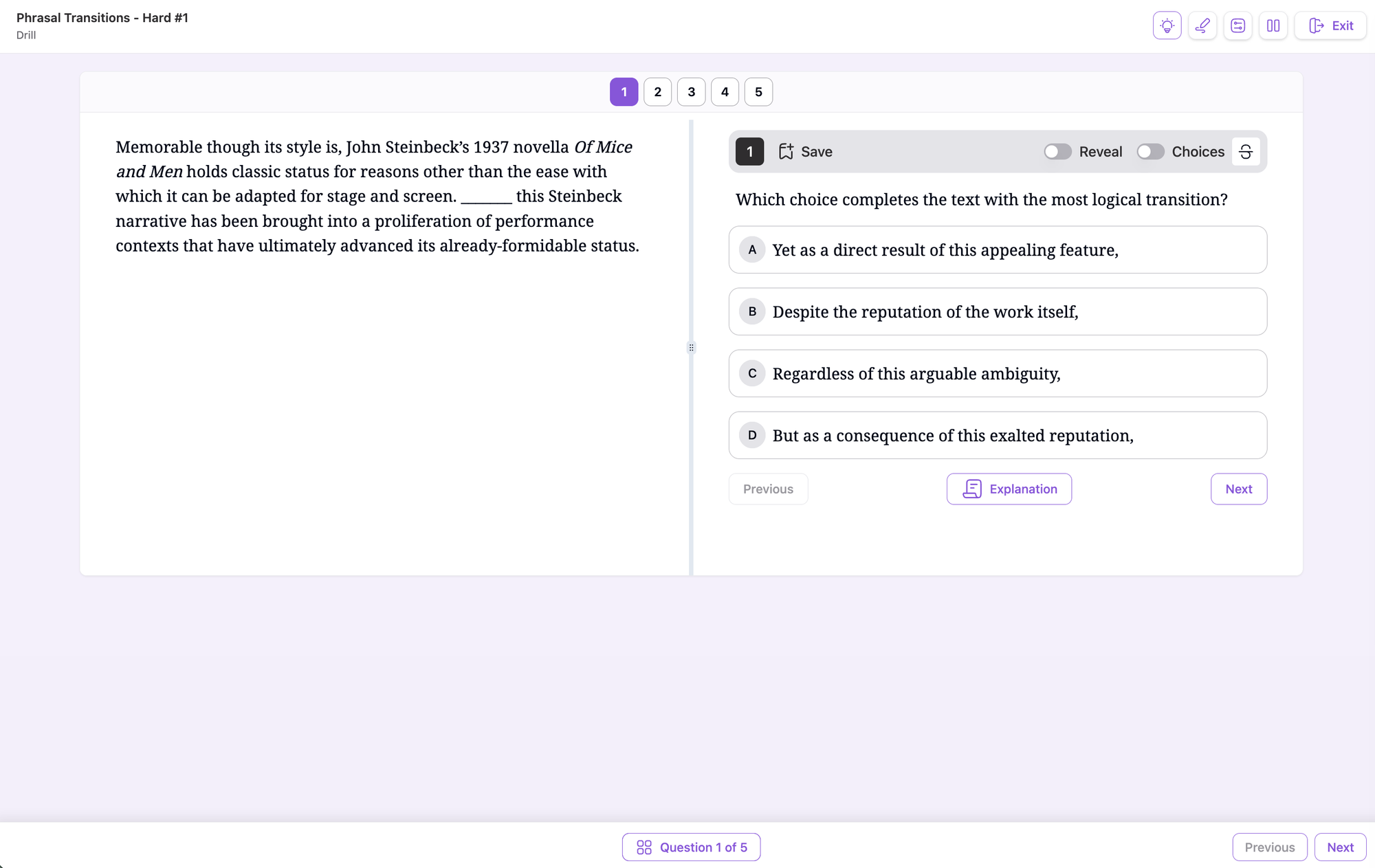
The job hasn't changed. Figure out the relationship between the two sentences first — same direction, opposite direction, cause, example — and then look at the choices. If you read the answer choices first, the long ones will fog you up. Decide the relationship before you shop.
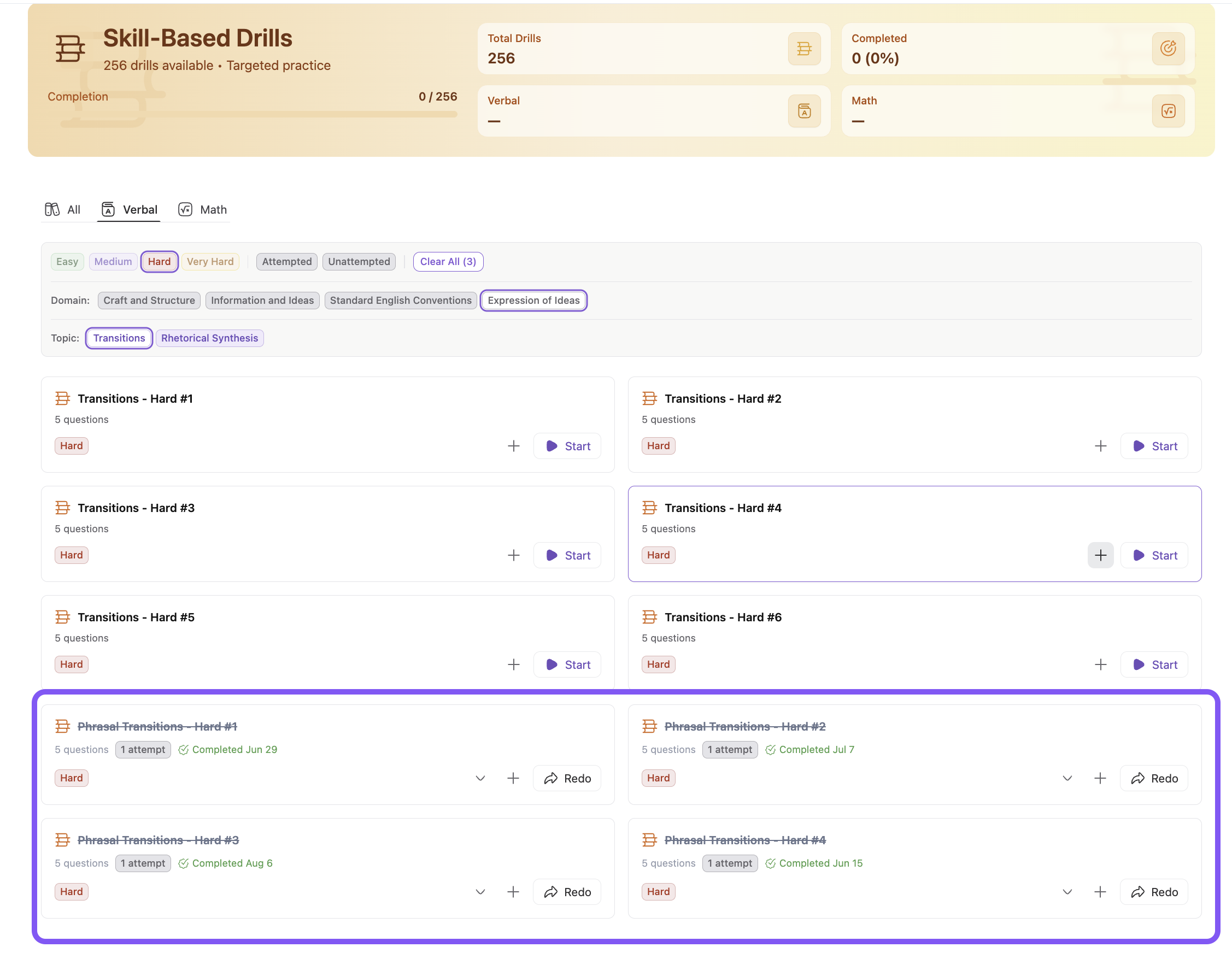
Brush up on these in The Gauntlet drills tonight. It's the only place you can find over 35 hand-written examples. You can't even find these on the College Board Question Bank!
8. Tonight and tomorrow morning
Review tonight, but review light. Go through your Gauntlet vocabulary and spend some time on phrasal transitions. That's the highest-value hour you can spend right now. Don't take a full practice test tonight and don't try to learn anything new.
Then sleep. You have the techniques you need to overcome the shenanigans on this test. Worrying about outcomes only makes them worse. Remember, the SAT isn't the "end-all-be-all."
Just be nonchalant ;-).
Tomorrow morning, get your body moving before you go. A walk, a jog, some pushups, anything. It wakes your brain up in a way that scrolling on your phone in the car does not.
One more thing: September is three weeks out
The September exam is right around the corner. Whatever happens tomorrow, there's no reason to let this momentum go.
You're at your sharpest right now. Every skill we've built is loaded and running. Three weeks from now you could walk in with all of that still intact, plus the experience of having just sat for a real administration — which is worth more than most people realize.
Last year, a lot of my students improved in September after taking August. Not because anything magical happened, but because they didn't stop. They kept drilling through the gap, they came back with real test experience, and their scores reflected it.
Don't let up. Take tomorrow off, celebrate, sleep in on Sunday. Then get back to it Monday.
Good luck tomorrow. I'll see you on the other side of it.
Oh! And don't forget to let me know what vocab words you see!
— Mr. John