
Six Words Moving Up in Frequency Before the August 22nd SAT (With Actual Data)


Before every SAT administration, I see a lot of popular SAT "gurus" making predictions on social media. "THESE 20 WORDS WILL BE ON THE AUGUST SAT." No data. No sourcing. No mention of where the list came from. Just twenty words, a fire emoji, and a caption telling your kid to comment "August SAT" for the full list. It's click-farming at its best.
All the while, the best kept secret in verifiably reused SAT vocab words is sitting right here for free.
But I can tell you which words are climbing — because I've been counting.
Twenty-five official administrations. March 2024 through June 2026.
334 unique words.
465+ total instances.
Every one cross-referenced against r/SAT reports and roots2words.com and my own students' observations, normalized for word variants, deduplicated where the same test got reported under two labels.
And this spring, six words moved in a pattern that tells you something about how the test is being built.
Here's what the data actually says.
First, what "moving up" actually means
A word doesn't get interesting because it's hard. It gets interesting because the College Board came back to it.
Here's the truth most test-takers never find out: the SAT recycles vocabulary systematically. Not occasionally — systematically. Across 25 administrations, certain words show up on five, six, even seven different tests. That's not coincidence. That's a defined pool of words the College Board considers essential for college readiness.
So when a word climbs from three appearances to four, the test is telling you something. It's not a new word. It's a confirmed word.
Six of them climbed this spring.
The spring 2026 climbers
| Word | Moved | Which Test |
|---|---|---|
| SUBSTANTIATE | 3 → 4 (Tier 2) | Mar '26 US, May '26 |
| UNDERMINE | 3 → 4 (Tier 2) | Jun '26 |
| HETEROGENEOUS | 3 → 4 (Tier 2) | May '26 |
| ATTENUATE | 4 → 5 (Tier 2) | May '26 |
| UNTENABLE | 2 → 3 (Tier 3) | Mar '26, May '26 |
| MISCONSTRUE | 2 → 3 (Tier 3) | Mar '26, May '26 |
Now look at what they mean
Read these six definitions:
substantiate — to provide evidence to support
undermine — to weaken gradually
attenuate — to reduce in force or intensity
untenable — impossible to defend or maintain
misconstrue — to interpret incorrectly
heterogeneous — diverse in character or content
Five of the six are argument words.
They're not describing objects. They're not describing feelings. They're describing what happens to a claim when evidence shows up. Supported. Weakened. Reduced. Indefensible. Misread.
That's not a vocabulary trend. That's a question-type trend.
The digital SAT leans hard on evidence-and-claim reasoning — Command of Evidence, text structure, cross-text connections. These words are the connective tissue of those questions. When a passage says a finding attenuated support for a hypothesis, the vocabulary word is the answer to the reasoning question. If you miss the word, you miss the point.
Which is why a definition list won't save you here. Your student needs to see these words doing work inside a sentence, in context, under time pressure. That's a different skill than recall, and one that I teach holistically through The Gauntlet, which uses these words throughout the questions, practice tests, and drills.
The three kings continue to reign supreme
While those six words were climbing, three words at the very top of the list continued their dominance.
ESCHEW — 7 appearances. Hit again in March '26 and June '26.
UBIQUITOUS — 7 appearances. Hit again in March '26 and June '26.
IDIOSYNCRATIC — 6 appearances. Hit again in June '26.
All three showed up this spring. Two years of data, 25 administrations, and the elite three just keep coming back.
If you're testing August 22nd and you don't know these three well enough to recognize eschewing in a sentence about 18th-century trade policy without slowing down — you better start studying.
New to the radar this spring
Four words entered the tracked list for the first time in the Spring School-Day administration: circumvent, elide, adhere, and anathema. Single appearances so far. Not urgent — but on the board now.
And ephemeral crossed from the single-occurrence list into medium-frequency. Prioritize it.
Where to actually practice these
Every word above came from a specific administration. Every administration has a free quiz on this site — flashcards, matching, roots, and SAT-style context questions. No gate. No signup. Go work the ones that match:
- June 2026 SAT Vocab Survey + Quiz (US + Int'l) — eschew, ubiquitous, idiosyncratic, undermine, disparate, (un)equivocal
- May 2026 SAT Vocab Survey + Quiz (US) — attenuate, heterogeneous, untenable, misconstrue, substantiate, epitomize, dearth, preclude
- May 2026 SAT Vocab Survey + Quiz (International)
- April 2026 School-Day Vocab Survey + Quiz — circumvent, elide, adhere, anathema, ephemeral, pernicious
- March 2026 SAT Vocab Survey + Quiz (US) — substantiate, untenable, misconstrue, multifariousness
- March 2026 SAT Vocab Survey + Quiz (International)
The full frequency breakdown — all 334 tracked words, sorted into Tier 1, Tier 2, Tier 3, medium-frequency, and single-occurrence — lives here:
👉 Vocabulary Trends from the Last Two Years of Official SATs
That's the master list. Everything else on this site feeds into it.
Two things before August 22nd
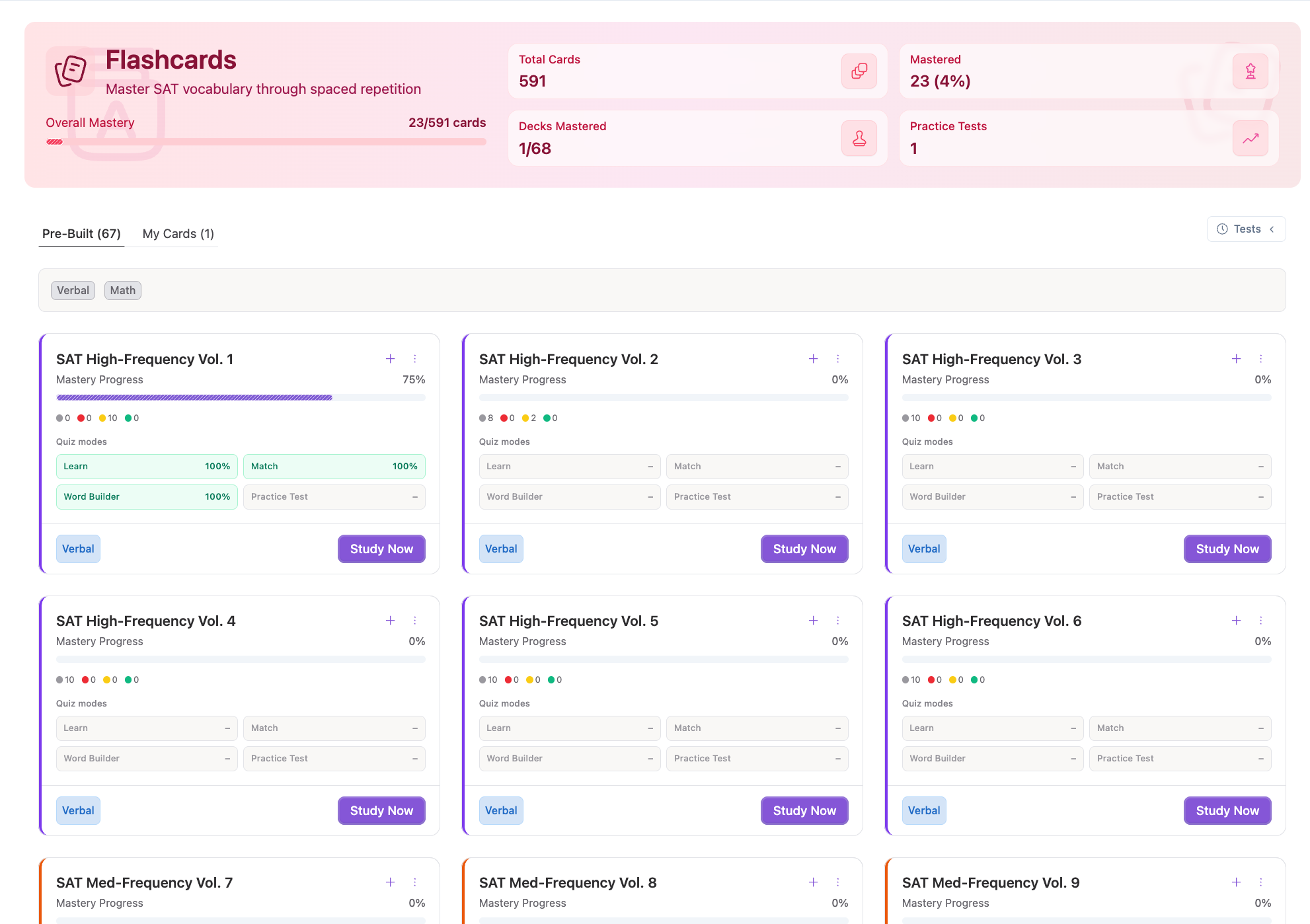
1. The free flashcard sets at Pass the Gauntlet.
Four modes per word set — flashcards, matching, fill-in-the-blank, and SAT-style context questions. Every set is built from the administrations above, which means your student isn't practicing generic vocabulary. They're practicing the words that actually appeared. And the best part is that they are organized according to highest frequency, so you'll be studying the highest impact words first.
2. The Gauntlet Ultimate SAT Vocabulary Challenge just cracked the top 10 in Amazon's Hot New Releases for SAT prep.
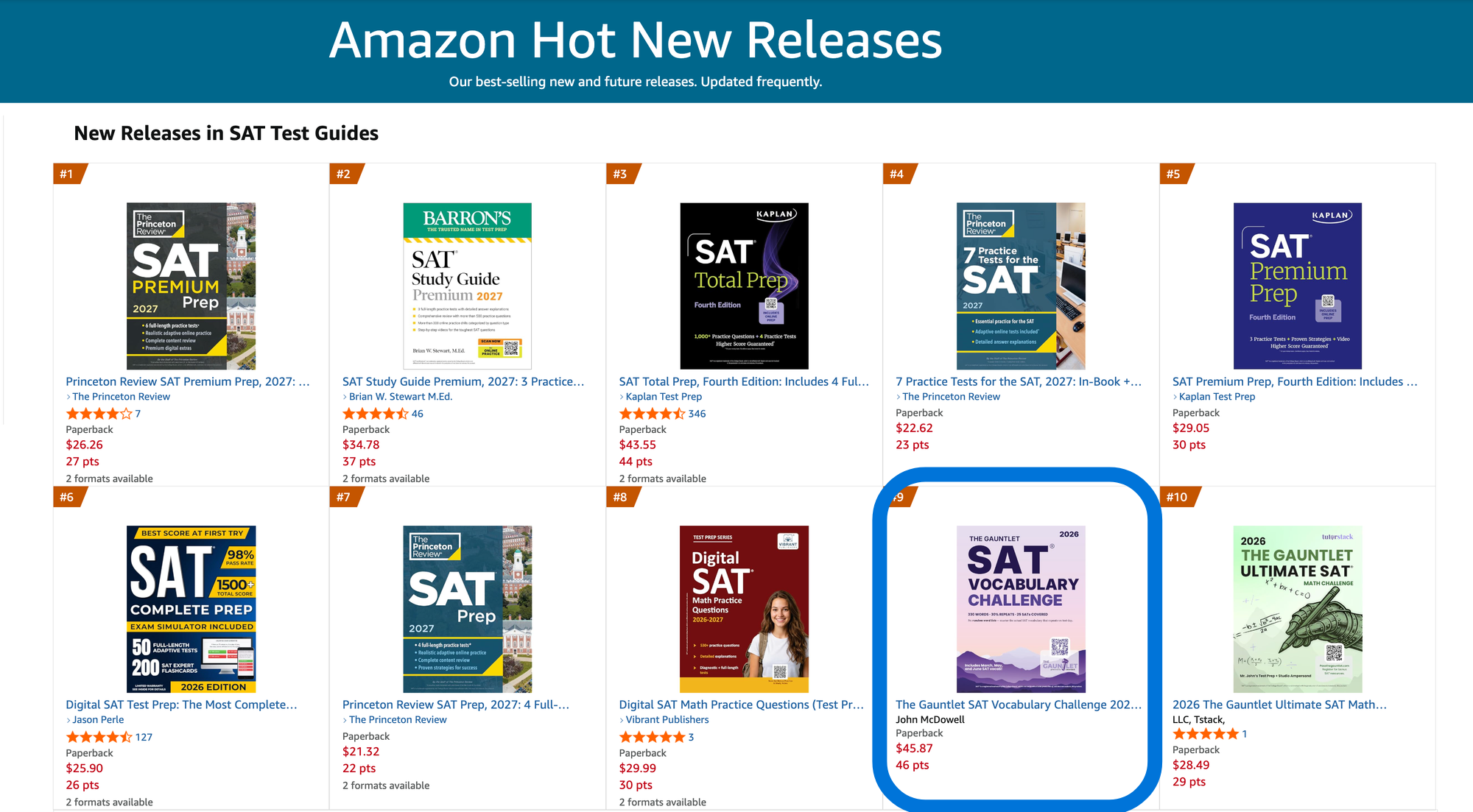
Right there with the stalwarts like The Princeton Review, Kaplan, and Barrons...and our Gauntlet Math Challenge (whoot!). We must be doing something right.
330 words. 33 volumes. Organized by the exact frequency tiers in this post — so Volume 1 starts with the words that have appeared most, not the words that start with a random category.
Each volume runs six modes: narrative passage, word match, word search, fill in the blank, word builder, and quiz time. Cumulative crosswords every three volumes, so nothing gets learned and then quietly forgotten two weeks later.
It's expert-written, built from official test data, by someone who sits for these tests himself.
👉 See it on Amazon's Hot New Releases
Six words moved this spring. Three words continue to dominate. That's not a prediction — that's a probability map.
The screenshot lists will keep coming. They'll be back in October, and December, and next March, with the same twenty words and the same fire emoji. Ignore them. Study the "usual culprits," as my students like to say, instead.
The air gets thin above 700. Vocabulary is one of the few places up there where you can still buy points with pure effort.
Keep grinding.
— Mr. John
*The SAT is a registered trademark of the College Board, with which Mr. John's Test Prep has no affiliation nor endorsement.