
Stuck in the Same SAT Score Range? Here’s How to Finally Break Through


You’ve been studying. You’re not slacking off. You’ve taken practice tests — maybe even the October SAT — and your score keeps landing in the same range. 1230… 1250… 1240. It barely moves.
Recently, a student and parent reached out to me with this concern and said, “Mr. John, I’m doing the practice tests. I’m following your techniques. I’m doing everything. It’s nice that we’ve had a big jump from my baseline score, but why am I still stuck?”
The truth is? It's not usually effort that’s the problem. It’s your approach.
Most students continue studying for the SAT when they should start training for it. Early prep builds knowledge. Score increases come when you shift from “learning content” to “refining performance,” fixing timing decisions, recognizing patterns, and eliminating small errors that cost big points.
With the next SAT around the corner, this is the point where preparation needs to become more precise.
This guide is built around one framework — the R.A.I.S.E. Method, the same process I use when a student’s score stops moving.
And like any good test prep, we start with clarity; understanding why your score is stuck in the first place.
Why Your SAT Score Isn’t Improving (And What That Actually Means)
When a student’s SAT score stays in the same range, it’s usually not because they aren’t trying. More often, it’s because the kind of work they’re doing only takes them so far.
Most students spend their time reviewing content — grammar rules, math formulas, vocabulary, and test strategies. That’s important, especially early in the process. But once you already understand most of the material, more review doesn’t automatically lead to a higher score.
At that point, what gets in the way usually isn’t knowledge. Its performance. Things like:
- Knowing the rule, but applying it too slowly
- Rushing and making small calculation errors
- Getting stuck on hard questions and running out of time
- Skipping questions too late — or not at all
- Repeating the same types of mistakes without noticing
That’s why your scores stall. Not because you’ve hit your limit, but because your preparation is still focused on learning, instead of improving how you perform under test conditions.
The good news is that this is fixable, and you don’t need to study longer to fix it. You need to start studying differently. And that begins with how you review your practice tests.
How to Get a Higher SAT Score (Without More Hours of Studying)
At a certain point in SAT prep, more worksheets, more flashcards, and more practice tests may not move your score. What makes the difference isn’t extra effort. It’s learning which mistakes are costing you points and fixing those on purpose.
To help students do that consistently, I use a system called R.A.I.S.E. It’s the process I teach when someone has the foundation in place but needs their score to actually go up. It’s not a trick or shortcut, just a clear way to turn practice into progress instead of another stagnant score.
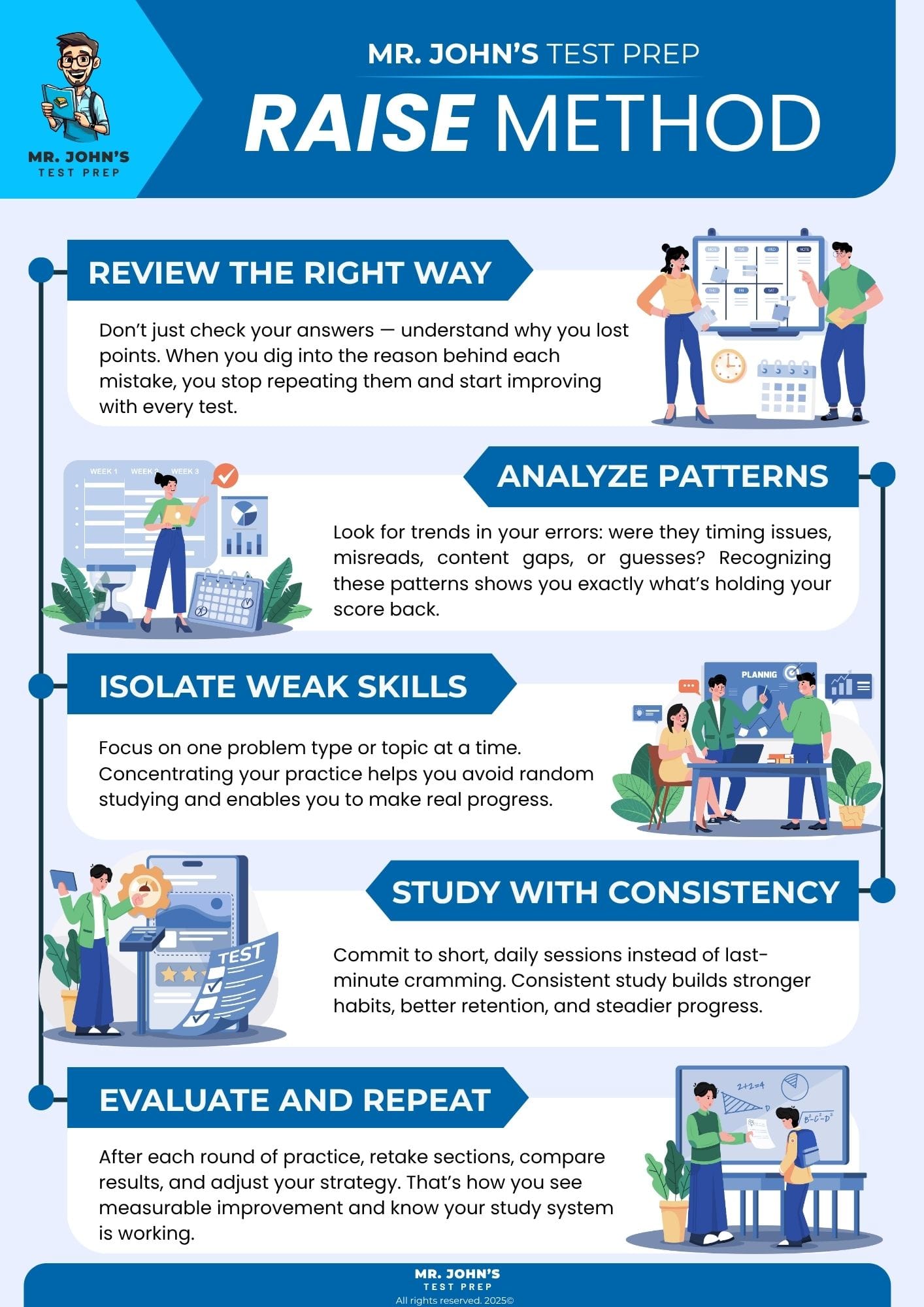
This method isn’t about perfection. It’s about creating a study system where every practice test leads to a higher score (not the same number again and again).
Step 1: How to Review a Practice SAT Test the Right Way
Most students complete a practice SAT, view their score, review a few answers, and then move on. That isn't a review, but score-checking. A real review tells you why you lost points.
After every practice test, go question by question and log mistakes. For each one, ask:
- Did I not know the content? (grammar rule, equation, vocabulary)
- Did I know it, but ran out of time?
- Did I understand it, but made a careless mistake?
- Did I get stuck, panic, or guess?
Once you start doing this consistently, your SAT score stops feeling random. You’re no longer “bad at math” or “stuck at 1230.” You’re losing points for reasons you can identify and fix.
Step 2: How to Analyze SAT Mistake Patterns
Seeing what you got wrong is only the start. Score improvement comes from seeing patterns in your mistakes.
Every SAT error falls into one of four categories:
| Mistake Type | What It Means | Example |
|---|---|---|
| Content Gap | You don’t know or fully remember the concept. | Forgot how to factor quadratics or when to use a semicolon. |
| Timing Issue | You knew how to solve it but didn’t finish in time. | Rushed the last four math questions and guessed. |
| Careless Error | You knew it and had time but made a small mistake. | Solved correctly but entered the wrong value in the grid-in. |
| Strategy Decision | You skipped your ISEE or PROVE-IT process and went straight to the choices. | Looked at answers before forming your own, or plug-and-chugged instead of proving it from the text. |
After sorting your errors, ask:
- Where am I losing the most points?
- Are my mistakes random or repeating?
- Do I not understand the concept, or do I understand it but can’t use it under time pressure?
This is what tutors do during score analysis. Once you know the type of mistake, you know the next step to fix it.

Step 3: How to Fix Weak SAT Skills Without Studying Everything
Once you know why you’re missing questions, don’t jump into another full practice test. That only repeats the same mistakes. Instead, isolate one skill at a time and master it.
How to Do It
- Choose one high-impact weak area. Not everything needs fixing. Pick the mistake type or topic that costs you the most points. Examples: comma usage, function word problems, and main idea questions.
- Gather 10–15 questions of only that type. Use Bluebook, the College Board Question Bank, The Gauntlet, or past tests you already took. This becomes your mini-drill.
- Practice slowly, without a timer. Solve each question. Then ask:
- What concept is being tested?
- What step slowed me down?
- Was it content, timing, or strategy?
If you miss multiple in a row → review the concept before doing more questions.
- Only after accuracy, add timing. When you’re consistently getting them correct, then practice under time. Accuracy first. Speed second.
Step 4: How to Practice with Consistency and Raise Your SAT Score
At this stage, the goal is not more hours, it’s higher-quality, more consistent practice. Once you’ve found the skill that’s costing you points, here’s how to improve it efficiently:
1. Ditch the lack of discipline for a better routine
Many students struggle to find consistent practice throughout the week. With the onslaught of AP classes and mid-semester tests, that’s no wonder. As tutors, we understand your weekly course load. But we don’t make excuses for you, because it only takes about 30 minutes per day.
2. Set a time you can commit to each day for practice.
I tell my students that 15-30 minutes each morning or night, or even during a lunch break, can be all you need to move the needle in the right direction. Set a reminder on your phone and just knock out 3-5 questions!
3. Add more time on weekends, like Saturday or Sunday mornings
Once the weekend comes around, start adjusting to a morning test schedule. Wake up early on Saturday and knock out your practice test or finish up your homework drills for the week.
4. Review before tutoring sessions, don’t cram.
The students with the biggest gains come into tutoring sessions with a productive week behind them – consistent practice and solid review of their mistakes. The students who plateau complete their homework an hour before the session begins. Don’t let that be you!
Step 5: How to Know If Your SAT Prep Is Actually Working
You don’t need a higher score to know you’re improving. The first signs show up in how you take the test.
You’re making real progress if:
- You’re not missing the same types of questions anymore.
- You’re finishing more sections on time, without rushing through the last few.
- Your careless mistakes drop. Fewer “I knew this, I just clicked the wrong thing.”
- You can explain why an answer is right, not just recognize it when you see it.
These are the signs tutors look for, because they appear before the score jumps.
You’re ready for another full practice test when:
- You’ve fixed at least one major weak area.
- Your mistakes are changing, not repeating.
- You’re scoring above 80% on focused practice sets.
- You can complete sections with control, not panic.
You’re ready for the real SAT when:
- Your last two practice scores are within about 30–50 points.
- Most mistakes are advanced, not basic content gaps.
- You can finish every section on time with a plan you trust.

Stop Guessing Your Way to a Higher SAT Score.
If your SAT score keeps landing in the same range, the answer isn’t another practice test; it’s fixing the way you’re training.
This method works when you commit to it. And if you want help doing it right, I’ll sit down with you, go through your test question by question, and tell you exactly where points are being lost and how to get them back. No wasted time. No generic study plans.
Here’s what to do next: Go to MrJohnTestPrep.com, send your latest practice test score or College Board score report, and I’ll tell you if I can help and how.
No missed question is a failure; it’s a point you can win back next time. Start now, while those points are still on the table.
Common Questions About Improving Your SAT Score
1. Why is my SAT score not improving even though I study?
You might be studying everything instead of fixing the specific kinds of questions you keep missing. Real improvement comes from reviewing why you lost points and practicing those areas on purpose.
2. How can I improve my SAT score fast?
Stop taking full practice tests back to back. Pick one common mistake and train only that until you stop missing it.
3. Do I need an SAT tutor to get a higher score?
Not always. But if you are tired of guessing what to fix, working with someone like MrJohnTestPrep can save time and show you exactly where you are losing points.
4. How many practice tests should I take before the SAT?
One full test per week with proper review is enough. Taking more without understanding your mistakes will not raise your score faster.
5. Can I still improve my SAT score in a month?
Yes. Most students do not need more time; they need a better strategy. Small and targeted changes can move your score even in a few weeks.
6. What does it mean if my score goes down instead of up?
It usually means timing issues, stress, or careless mistakes, not that you are getting worse. This is when a better review routine or a coach like MrJohnTestPrep can help.
7. Should I take the next SAT or wait for the one after?
Take it if your practice scores are improving and most of your mistakes are timing or careless errors. Wait, if you still do not understand key math or grammar rules, and need to review content first.