New Quizzes Posted + Watch out for the Jan-Febs!


Welcome to 2026, MJTP families!
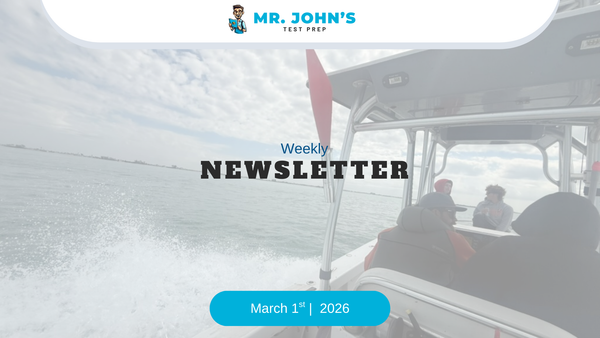
Isn't that a beautiful banner image? We had an amazing sunset over Anna Maria Island this week, and I just had to share.
I hope everyone had a restful holiday break. School starts back for me tomorrow, and I'm excited to see my students in person again—and equally looking forward to connecting with familiar faces online. There's something energizing about the start of a new semester, especially with spring SAT season right around the corner.
I remember my days at McCallie this time of year. Mr. Mancke, the school counselor, always encouraged us to get through the "Jan-Febs" – that time of year when days seem dreary and cold and you're just looking ahead to spring break. If your student (or you!) is feeling this, keep your head up and keep chugging through. Here are a few things that help:
- Small wins matter. Don't wait for massive breakthroughs. Finished one practice passage? That counts. Reviewed ten vocab words? Progress.
- Routine is your friend. When motivation is low, discipline carries you through. Same study time, same spot, same playlist—whatever creates consistency.
- Move your body. Even a short walk outside (yes, even in the cold) can reset your mental state more than another hour on the couch. I love red-light therapy as well.
- Set a target date. Having something concrete to work toward—like the March SAT—gives structure to these otherwise formless winter weeks.
The Jan-Febs don't last forever. Spring is coming, and so is progress. We just have to keep showing up until the momentum returns.
The Vocabulary Project: What I've Been Working On
Over the break, I dove deep into analyzing vocabulary patterns across every r/SAT official SAT vocabulary report administered in 2024 and 2025. This data came from the same quizzes I create for my students. The goal? To figure out which words College Board actually tests most frequently—not just what prep books guess might appear.
The results were fascinating. Out of 239 unique vocabulary words tested across 20 different SAT administrations, I identified 26 high-frequency words that appeared three or more times. Some words, like eschew and ubiquitous, showed up on at least five separate tests. Others, like proponent, conjecture, and attenuate, appeared four times each.
I've organized these into three tiers:
- Tier 1 (5 appearances): eschew, ubiquitous
- Tier 2 (4 appearances): proponent, conjecture, attenuate, manifest, exacerbate, idiosyncratic, abridge, index
- Tier 3 (3 appearances): equivocal, abate, capacious, quintessential, anomalous, belie, enumerate, vindicate, undermine, tenuous, transpose, underscore, precede, evince, ameliorate, incongruous
I also discovered that on the May 2025 and November 2024 SATs there were 17 words that overlapped – strong evidence that College Board is recycling vocabulary, and perhaps even whole tests.
You can find the full report here: https://www.mrjohnstestprep.com/vocabulary-trends-from-the-two-years-of-official-sats/
A Personal Reflection on Learning
I want to share something a bit more personal this month.
2025 was a year of steep learning curves for me. I've been working on two projects—one directly related to tutoring—that required me to venture into the world of software development. Frontend coding, backend systems, figuring out how to translate my ideas into actual working tools. I relied heavily on others at first, and honestly? It was expensive. Some of those "investments" didn't pan out the way I hoped.
But here's what I've learned: at the end of the day, you really have to take ownership of the implementation of your vision. Guides, tutorials, and expert advice will help you along the way—they'll point you in the right direction and save you from some pitfalls. But there's no substitute for the process of figuring it out yourself. Those expensive "mistakes"? They were really just learning experiences. Every dead end taught me something. Every failed approach narrowed down what actually works.
I share this because I think it's directly relevant to what our students experience. The process of learning is deeply personal and individualistic. What clicks for one student might not work for another. The path from confusion to understanding is rarely a straight line. And sometimes the most valuable lessons come from the attempts that didn't work out the way we planned.
So if your student is struggling with a concept, or feeling frustrated that things aren't clicking as quickly as they'd like—remind them that this is normal. This is the process. The goal isn't to avoid difficulty; it's to work through it and come out stronger on the other side.
Spring SAT Season: Let's Make a Plan
The March SAT is coming up fast, and many schools offer spring school-day SATs in April and May. If you're targeting any of these test dates, now is the time to put a plan together.
Reach out and let's talk strategy. I have some new "hard" material I'm itching to try out with students who are ready for a challenge. Whether we're building foundational skills or pushing for those final score improvements, I'd love to help map out a path forward.
You can reply directly to this email or book a meeting through my website.
Resources
The high-frequency vocabulary quizzes and flashcards are now live on the Mr. John's Test Prep website. Students can:
- Read context passages that use all target words naturally
- Practice with interactive flashcards (with roots and etymology!)
- Test themselves with SAT-style matching and multiple-choice questions
- Generate completion reports to track progress
Check them out and let me know what you think!
Looking forward to a great spring semester. See you this week—whether in person or online.
Best,
Mr. John
Mr. John's Test Prep
P.S. — If you know a family preparing for spring SATs who might benefit from this vocabulary analysis, feel free to forward this newsletter along. The more prepared students we have, the better!