AI May Have Just Solved Math's Most Famous Problem. You Still Need to Know Algebra for the SAT.

Dear MJTP families and friends,
The December 5 SAT is one week from today. I'll get to that at the bottom. First, though, something happened in the math world last week that's worth chatting about. It had me up a little early on a Saturday, pondering the implications of the speed of advancements we are making in recent years with the help of ai.
The Riemann hypothesis, explained for parents
In 1859, a German mathematician named Bernhard Riemann made a guess about something called the zeta function. If his guess was right, it would explain a deep pattern in how prime numbers are spread out along the number line. Mathematicians have spent 167 years trying to prove it. It's one of the seven Millennium Prize Problems, which come with a $1 million award from the Clay Mathematics Institute, and a lot of mathematicians considered it the most important unsolved problem in the field.

On November 20, Levent Alpöge, a mathematician at the AI company Anthropic, posted a proof that he developed with Anthropic's AI model, Claude. The proof is written in Lean, a programming language in which a computer checks every logical step. The next day, the groups that maintain Lean and its math library announced that they'd verified it. The original version ran about 17 million lines of code, and much shorter versions have been posted since.
I'm saying "may have" on purpose. The computer check has passed, but mathematicians are still working through the argument the traditional way, and the Clay Institute hasn't awarded the prize (and likely won't for a few years). Yet, while we wait, ai is now explaining it to all of us mere mortals in fun little visuals on social media:
The Riemann Hypothesis Proof, Mapped File by File
— Matheorems (@matheorems) November 24, 2026
The Lean proof of the Riemann Hypothesis has 60,790 files and 16,984,346 lines. Levent Alpöge released it on November 20, 2026, after working with Claude. Every nontrivial zero of ζ(s) has Re s = 1/2.
The trunk is the longest… https://t.co/dwoxocsbbJ pic.twitter.com/puUdbSPdYi
This isn't a big surprise when you consider recent advancements in ai
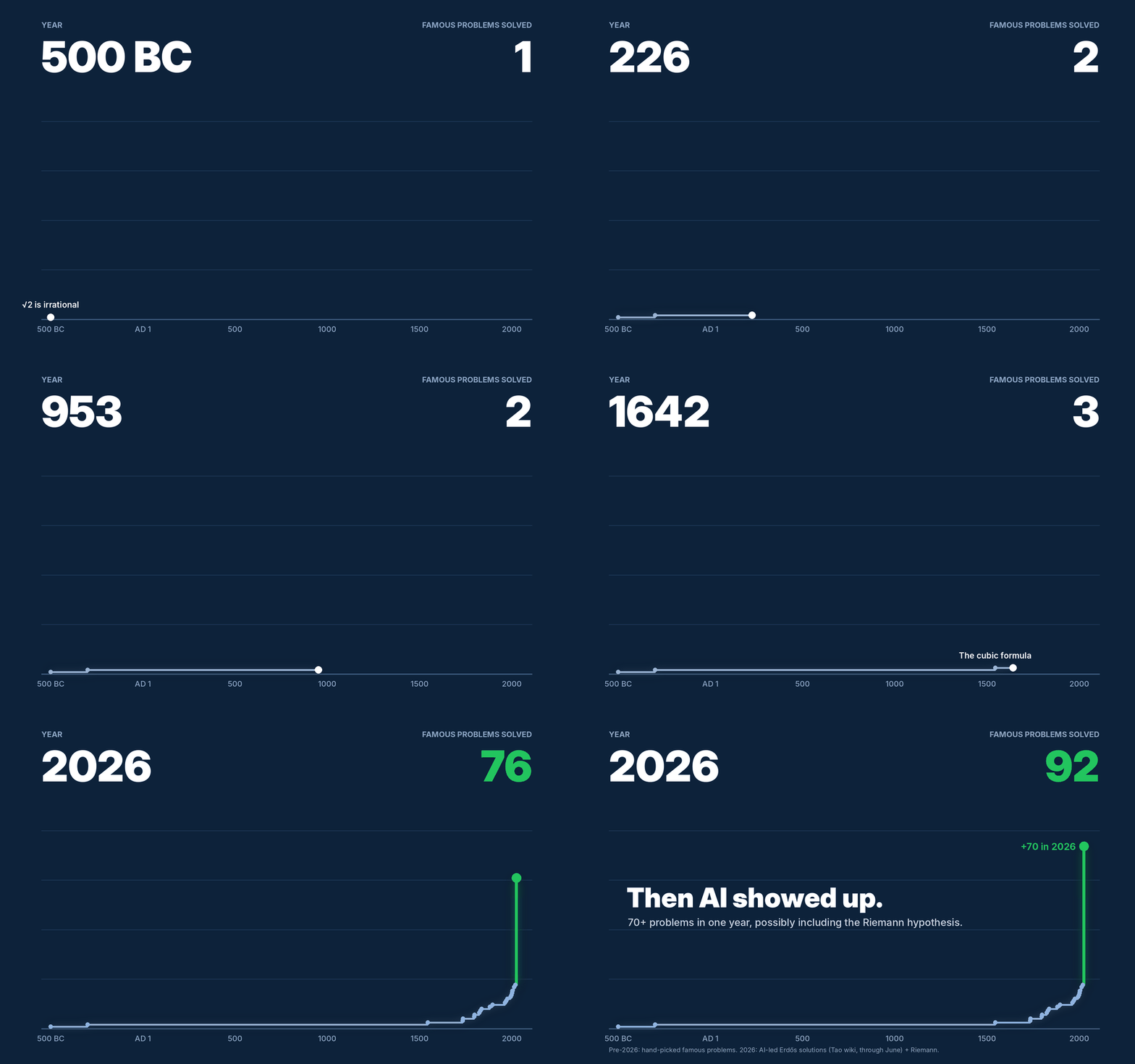
Riemann may be the headline this week, but it caps off a year-long streak of impressive solutions. Paul Erdős, the famous Hungarian mathematician, left behind more than a thousand unsolved problems. In January, Terence Tao, probably the best-known mathematician alive, announced that one of them had been solved almost entirely by AI. By the end of June, a community-run tracker listed dozens more where AI played the main role. In May, OpenAI announced that its model had disproved an Erdős conjecture from 1946.
The chart animation below puts the pace of ai-solved math problems in perspective compared to the rest of human history:
What does this mean for our students?
Could AI's competency in math make people who understand math more valuable? Nobody can read 17 million lines of proof by hand. Yet, somebody still has to know what question to ask, whether the answer makes sense, and what to do with it. That takes fluency, the kind of comfort with numbers and algebra that lets you spot when something's off.
We all know that ai can make mistakes. Despite it's rapid improvement, it can't be fully trusted, yet.
Not only can it not be fully trusted, but what is it doing to human development? The University of California system stopped using SAT and ACT scores in admissions a few years ago. Since then, a UC San Diego faculty report found that the number of freshmen in remedial math courses went from 32 in 2020 to 921 by fall 2025, and that about one in eight entering students fell below middle-school math. Across the UC system, more than two-thirds of math faculty, along with five Nobel laureates, have signed open letters asking the university to bring back SAT or ACT math scores. One Berkeley professor described office hours that should be about integrals turning into lessons on fractions.
So in the same year that a machine may have solved the hardest problem in mathematics, one of the country's top public universities is teaching its freshmen middle-school math. This raises important questions about the importance, or even obsolescence, of human knowledge.
Desmos and the SAT
The digital SAT has already moved closer toward this paradigm. Every math question in Bluebook comes with a built-in Desmos calculator, with both a graphing mode and a scientific mode. Desmos is powerful. It can graph a system of equations, find an intersection, or run a regression in seconds.
But Desmos can't tell you what to type in. On the hard second module, the student who understands the algebra knows whether Desmos will save a minute or waste two. Some questions fall apart on a graph. Others are faster with pencil and paper, and a few are traps for students who graph first and think later.
What we're building: The Gauntlet 800 Math Guide
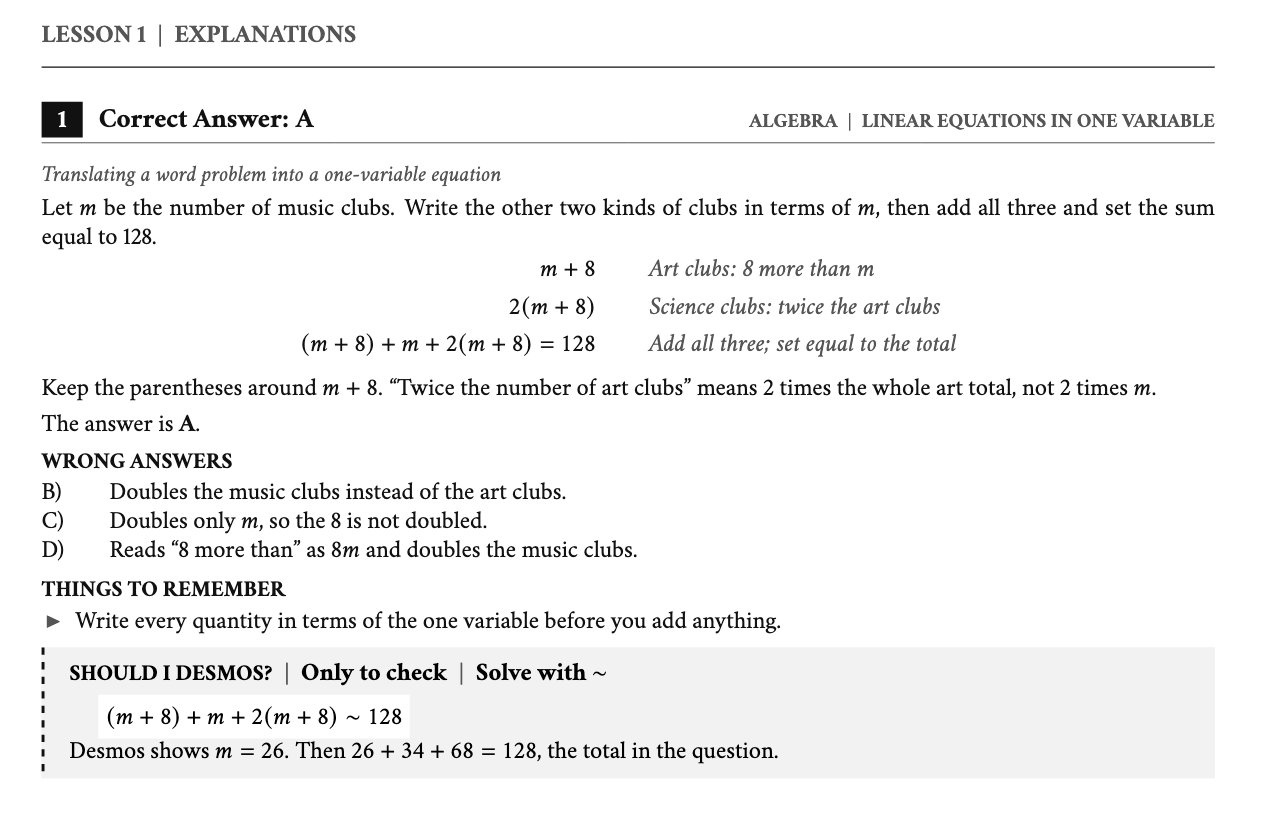
That's the idea behind the book we're finishing right now, The Gauntlet 800 Math Guide, which focuses on hard module 2 questions and comes out on December 14. After every question, we include a "Should I Desmos?" tip that tells you whether the calculator is the fastest route, a useful check, or a distraction, and why. The goal isn't to make students dependent on the tool or afraid of it. It's to teach the judgment the UC professors say is missing, which is the same judgment that'll matter more as AI does more of the heavy lifting.
December 5 SAT: one week out
The December 5 SAT is next Saturday. Registration is closed, and this is the last SAT until March.
If you're registered for December, spend this week on vocabulary. Work through the November and October vocab quizzes on the site, since those are the most recent words we've seen on official tests. Run through the free Gauntlet Vocab Stacks as well.
If you tested this fall and didn't get the score you wanted, now's the time to start studying for March. The March SAT is on March 6, 2027, and the registration deadline is February 19. That gives you about three months, which is plenty of time to make a real jump if you start now instead of in February.
Good luck to everyone testing next week, and I hope you have had a restful week off from school.
Mr. John