
Vocabulary trends from the last two years of official SATs

With a little help from AI, I've compiled some data trends on the tough vocabulary words that r/SAT moderator "yodatsracist" and roots2words.com have documented for all documented SATs from March 2024 through December 2025.
After analyzing every SAT vocabulary quiz from March 2024 through December 2025, we identified the 26 words that the College Board tests most frequently—and the patterns that can help you study smarter, not harder.

Why This Analysis Matters
Here's a truth about SAT prep that most test-takers don't realize: the College Board recycles vocabulary. Not occasionally—systematically. After compiling data reported by r/SAT forums and roots2words.com from 20 official SAT administrations spanning nearly two years, we discovered that certain words appear on three, four, even five different tests.
This isn't random. These high-frequency words represent the vocabulary the College Board considers essential for college readiness. If you're serious about maximizing your SAT score, these are the words that deserve your attention first.
The Numbers at a Glance
| 📊 Metric | Value |
| Tests Analyzed | 20 |
| Total Unique Words | 239 |
| Total Word Instances | 361 |
| High-Frequency Words (3+ appearances) | 26 |
| Medium-Frequency Words (2 appearances) | 58 |
| Single-Occurrence Words | 155 |
🔥 The 26 Most-Tested SAT Words (2024-2025)
These words appeared on three or more SAT administrations. Master these first—they represent your highest-probability vocabulary investments.
Tier 1: The Elite Two (5 Appearances Each)
| Word | Definition | Tests |
|---|---|---|
| ESCHEW | To deliberately avoid or keep away from | Aug '24, Nov '24, May '25, Jun '25, Oct '25 PSAT |
| UBIQUITOUS | Present, appearing, or found everywhere | Nov '24, Mar '25, May '25, Jun '25, Aug '25 |
Tier 2: The Power Eight (4 Appearances Each)
| Word | Definition | Tests |
|---|---|---|
| PROPONENT | A person who advocates for something | Mar '24, Aug '24, Nov '24, Mar '25 |
| CONJECTURE | An opinion based on incomplete information; to guess | Mar '24, Oct '24, Jun '25, Dec '25 |
| ATTENUATE | To reduce in force, value, or intensity | Aug '24, Nov '24, May '25, Aug '25 |
| MANIFEST | Clear or obvious; to display clearly | Mar '24, Aug '24, Mar '25, Sep '25 |
| EXACERBATE | To make a problem or situation worse | Oct '24, Nov '24, Jun '25, Aug '25 |
| IDIOSYNCRATIC | Peculiar to an individual; distinctive | Mar '24, May '25, Jun '25, Oct '25 |
| ABRIDGE | To shorten or condense | Aug '24, Oct '25, Nov '25, Dec '25 |
| INDEX | An indicator, sign, or measure | Nov '24, Mar '25, Aug '25, Sep '25 |
Tier 3: The Reliable Sixteen (3 Appearances Each)
| Word | Definition | Tests |
|---|---|---|
| EQUIVOCAL | Open to multiple interpretations; ambiguous | Mar '24, Nov '24, May '25 |
| ABATE | To reduce in intensity or amount | Aug '24, Mar '25, Jun '25 |
| CAPACIOUS | Having a lot of space; roomy | Aug '24, Jun '25, Oct '25 PSAT |
| TRANSPOSE | To transfer or reverse position | Oct '24, Mar '25, Sep '25 |
| INCONGRUOUS | Out of place; not harmonious | Oct '24, Dec '24, Dec '25 |
| ANOMALOUS | Deviating from the norm; irregular | Oct '24, Nov '24, May '25 |
| AMELIORATE | To make something better | Nov '24, May '25, Dec '25 |
| EVINCE | To reveal or display clearly | Nov '24, May '25, Oct '25 PSAT |
| PRECEDE | To come before in time or order | Nov '24, Mar '25, May '25 |
| TENUOUS | Very weak or slight; flimsy | Nov '24, May '25, Oct '25 PSAT |
| VINDICATE | To clear of blame; to prove right | Nov '24, May '25, Dec '25 |
| UNDERSCORE | To emphasize or highlight | Dec '24, Oct '25, Nov '25 |
| ENUMERATE | To list or count one by one | Mar '25, Oct '25, Nov '25 |
| BELIE | To contradict or give a false impression | May '25, Oct '25 PSAT, Dec '25 |
| UNDERMINE | To weaken or damage gradually | Jun '25, Oct '25, Nov '25 |
| QUINTESSENTIAL | Representing the most perfect example | Aug '25 US/Int'l, Sep '25 |
Pattern Analysis: What the Data Reveals
1. Root Word Families Dominate
The College Board clearly favors words that share Latin and Greek roots. Notice how these word families appear repeatedly:
The EQUI- Family (equal): equivocal, unequivocal
The -GRUOUS Family (fitting): incongruous, incongruence
The -SCRIBE/-SCORE Family (write): underscore, ascribe
The -MINATE/-MINE Family: undermine, enumerate
The -DICATE Family: vindicate, indicate
Strategic Takeaway: Learning root words gives you leverage across multiple vocabulary questions. Master one root, recognize many words.
2. Negative Prefixes Are High-Value Targets
Words with negative prefixes (un-, in-, ir-, im-) appear disproportionately in high-frequency lists:
- INCONGRUOUS (3x)
- ANOMALOUS (3x)
- INEXPLICABLE (2x)
- IRREFUTABLE (2x)
- INSURMOUNTABLE (2x)
- IMPERVIOUS (2x)
Strategic Takeaway: Pay special attention to words that negate or reverse meaning. The SAT loves testing whether students understand how prefixes transform word meaning.
3. The November-May Connection
Our analysis revealed an interesting pattern: November 2024 and May 2025 share an unusually high number of words. This suggests the College Board may reuse word banks across certain testing windows.
Words appearing on both tests: alleviate, ameliorate, anomalous, eschew, equivocal, evince, exacerbate, facetious, idiosyncratic, inexplicable, precede, proponent, rescind, surreptitious, tenuous, ubiquitous, vindicate
College Board clearly has favorites—and now you know what they are.
4. August Tests Feature the Most Vocabulary
August 2025 US contained 38 vocabulary words—the highest concentration of any single administration. Students taking August tests should prepare for vocabulary-heavy passages.
📊 Complete Frequency Distribution
Medium-Frequency Words (2 Appearances)
These 58 words appeared on exactly two tests. They represent strong candidates for future repetition:
| exhaustive preclude irrefutable sporadic capricious conflate cursory discerning epitomize imperious abound decisive emanate excise expound heterogeneous impervious impugn lambaste |
outmoded pernicious synopsis testament unnerved heterogeneity exploit substantiate insurmountable corroborate appraise alleviate facetious inexplicable rescind surreptitious eclipse copious proxy meticulous |
attrition contentious dearth denote supplant augment harbinger pervade discrepancy partition circumspection epitome supersede perceptible intermingle redundancy incongruence reprisal pretext |
Single-Occurrence Words (155 Words)
These words appeared exactly once across all 2024-2025 SAT administrations. While less frequently tested, they represent important vocabulary that could appear on future exams:
| accommodate aesthetic affinity affront aggregation align amass ambiguous amorphous analogous anomaly anthropogenic ascribe attest authentic banal begrudge burgeoning casual catalyze cite coalesce commend complacent confounded conspicuous continuity culled decouple decry detractor detrimental diffusion diminution diminutive discretion disparate disparity dispassionate dispersed disquieting dissonance dogmatic durability dwindling embellished emblematic emissary engender entangled entice extemporaneous |
expansive expedite extensibility extraneous feasible fecund foment forestall forsake foster fraudulent halting hypothesize iconoclasm idle immoderate impartial imperative imposing inaugurate inconspicuous indigenous indoctrinate indolence induce inertia inestimable inherent inimical intercede inure invariable invoke juxtapose magnify misconstrue mitigate modulate monetizing multifariousness mutable myriad nebulous neutral nonchalance notional obtrusive orthodox oscillate palpable paucity permeability |
perturbation placate precursor preempts preliminary premiering pretentious propagate provoke prudent quotidian recapitulate reciprocity rectify refute reiterate renounce replicable resolute sanction sentimental situate sophist sophisticated steward stipulate subdue subjugate subordinate substantial substantiate subsumes subtlety superficial superfluous surmount synthesis tranquil unambiguous underpinned unequivocal unfounded universal unsympathetic untenable utilitarian vacillate verisimilitude vindictive visionary warranted wrought |

🎯 Your Study Strategy: The Priority System
Based on this data, here's how to allocate your vocabulary study time:
Priority 1: Master the 26 High-Frequency Words First
These words have the highest probability of appearing on your test. Ensure you can define them, use them in context, and recognize them in various sentence structures. Time investment: 40% of your vocabulary study.
Priority 2: Study the 58 Medium-Frequency Words
These represent strong candidates for repetition. Focus on understanding their roots and relationships to other words. Time investment: 35% of your vocabulary study.
Priority 3: Familiarize Yourself with Single-Occurrence Words
Review these for general familiarity, but don't invest disproportionate time. Many may never repeat. Time investment: 25% of your vocabulary study.
📅 Tests Included in This Analysis
- March 2024 SAT
- June 2024 SAT (Rounds 1 & 2)
- August 2024 SAT US (Rounds 1 & 2)
- August 2024 SAT International (Rounds 1 & 2)
- October 2024 SAT (Rounds 1 & 2)
- November 2024 SAT (Rounds 1 & 2)
- December 2024 SAT (Rounds 1 & 2)
- March 2025 SAT (Rounds 1 & 2)
- May 2025 SAT (Rounds 1 & 2)
- June 2025 SAT (Rounds 1 & 2)
- August 2025 SAT US (Rounds 1-3)
- August 2025 SAT International (Rounds 1 & 2)
- September 2025 SAT US (Rounds 1-3)
- October 2025 SAT US (Round 1)
- October 2025 SAT International (Round 1)
- October 2025 PSAT (Rounds 1 & 2)
- November 2025 SAT US
- November 2025 SAT International
- December 2025 SAT US
- December 2025 SAT International
Methodology Notes
This analysis compiled vocabulary from official SAT administrations as reported by test-takers on r/SAT. Word variants (e.g., "proponents" and "proponent," "eschewed" and "eschew") were normalized to base forms for accurate frequency counting.
We identified and excluded apparent duplicates where the same quiz data appeared under multiple labels, ensuring each test administration was counted only once.
What This Means for Your Prep
The SAT isn't testing random vocabulary—it's drawing from a defined pool of words the College Board considers essential. By focusing on high-frequency words first, you're aligning your study time with the test's actual patterns.
This data-driven approach means you can study smarter: master the 26 most-tested words, understand their roots, and build outward from there. The probability math is in your favor.
Ready to Practice these words?
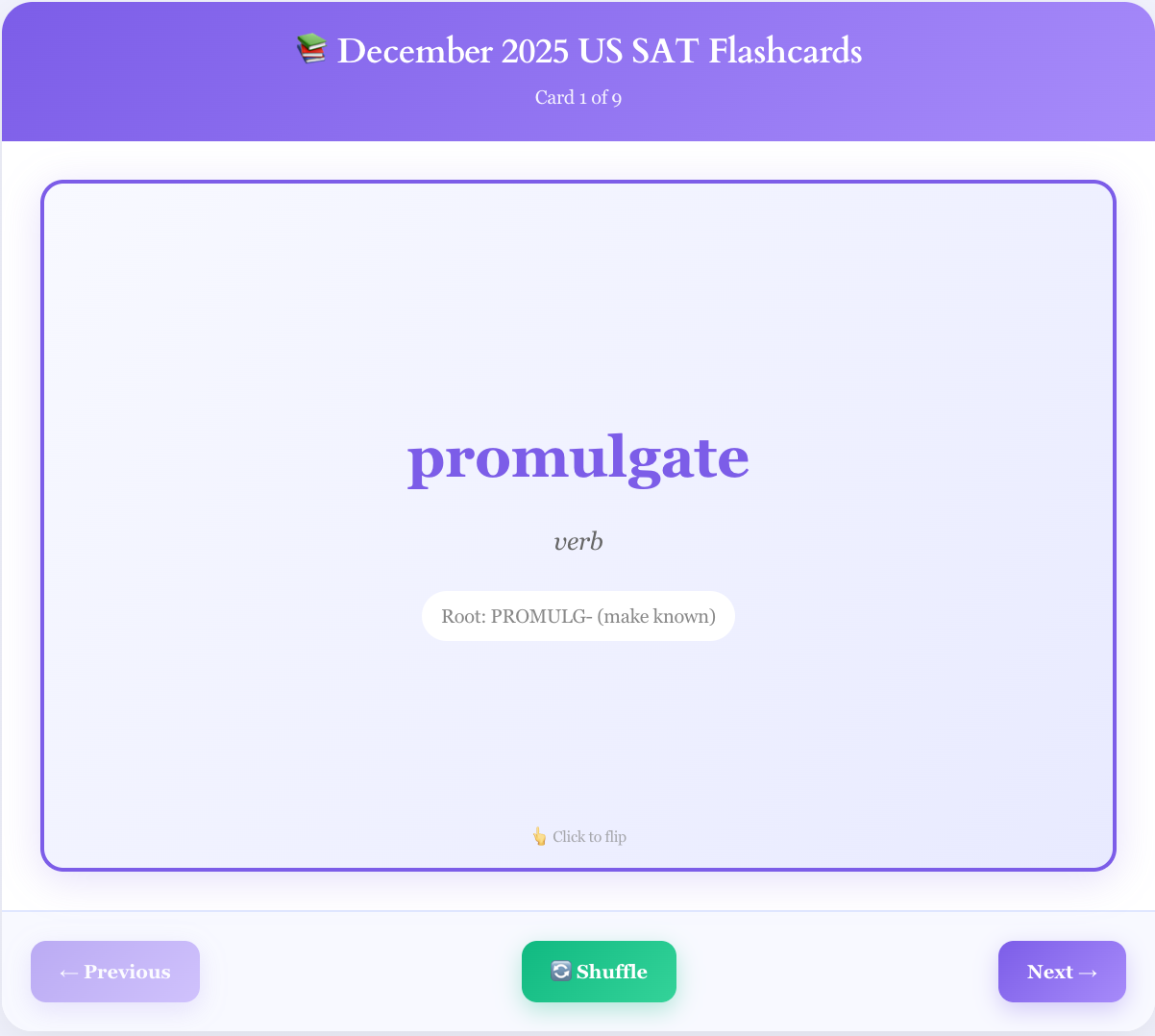
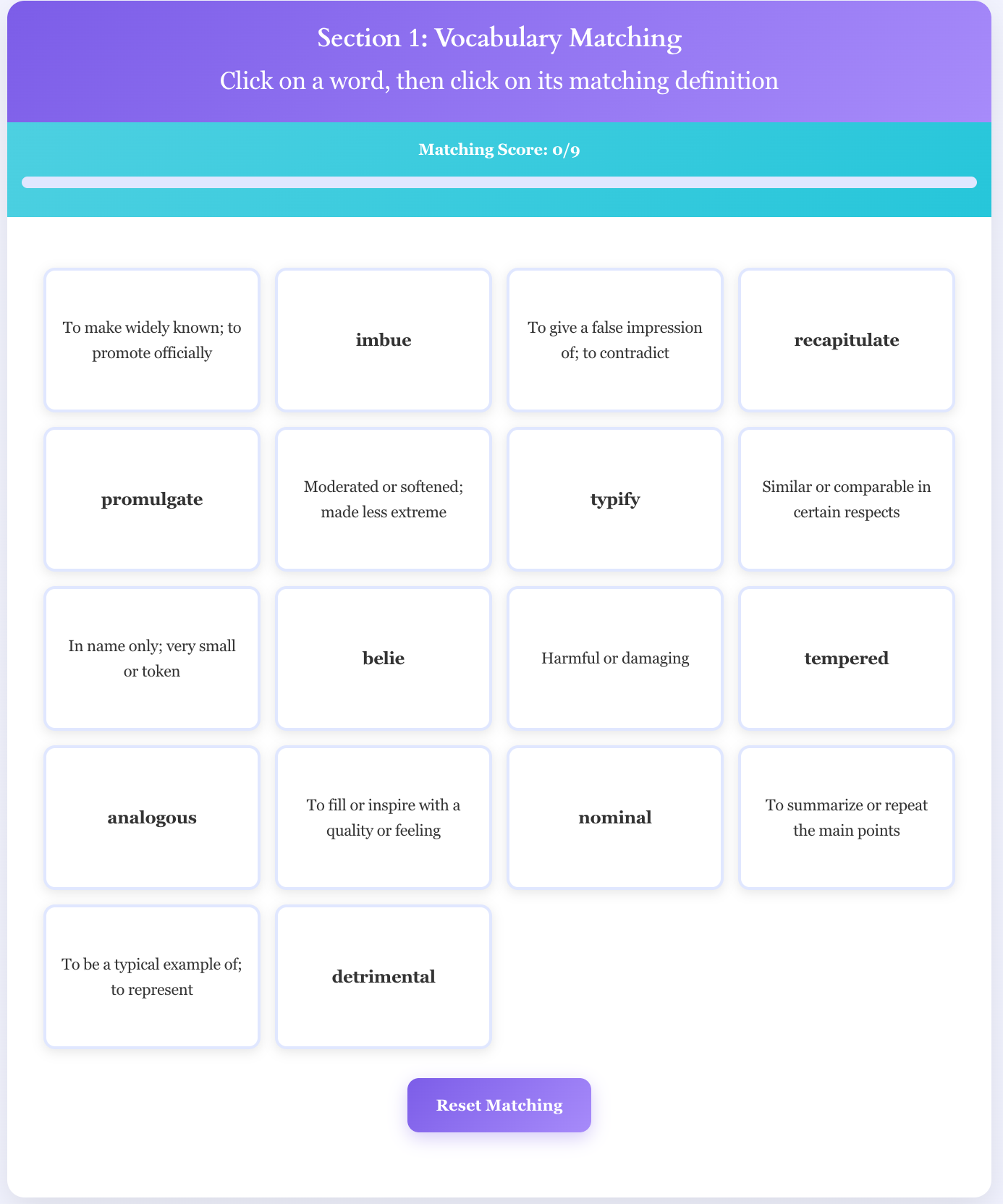
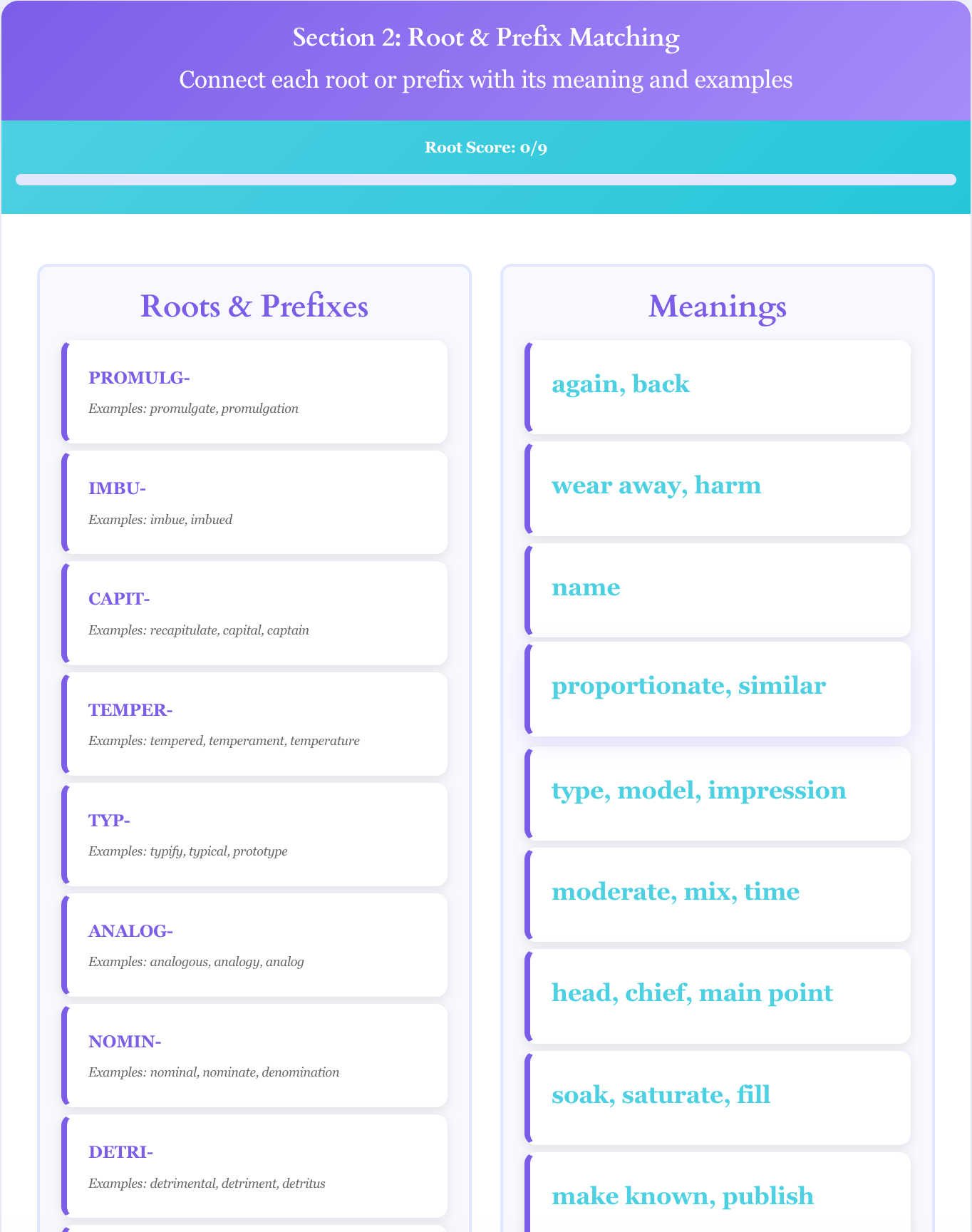
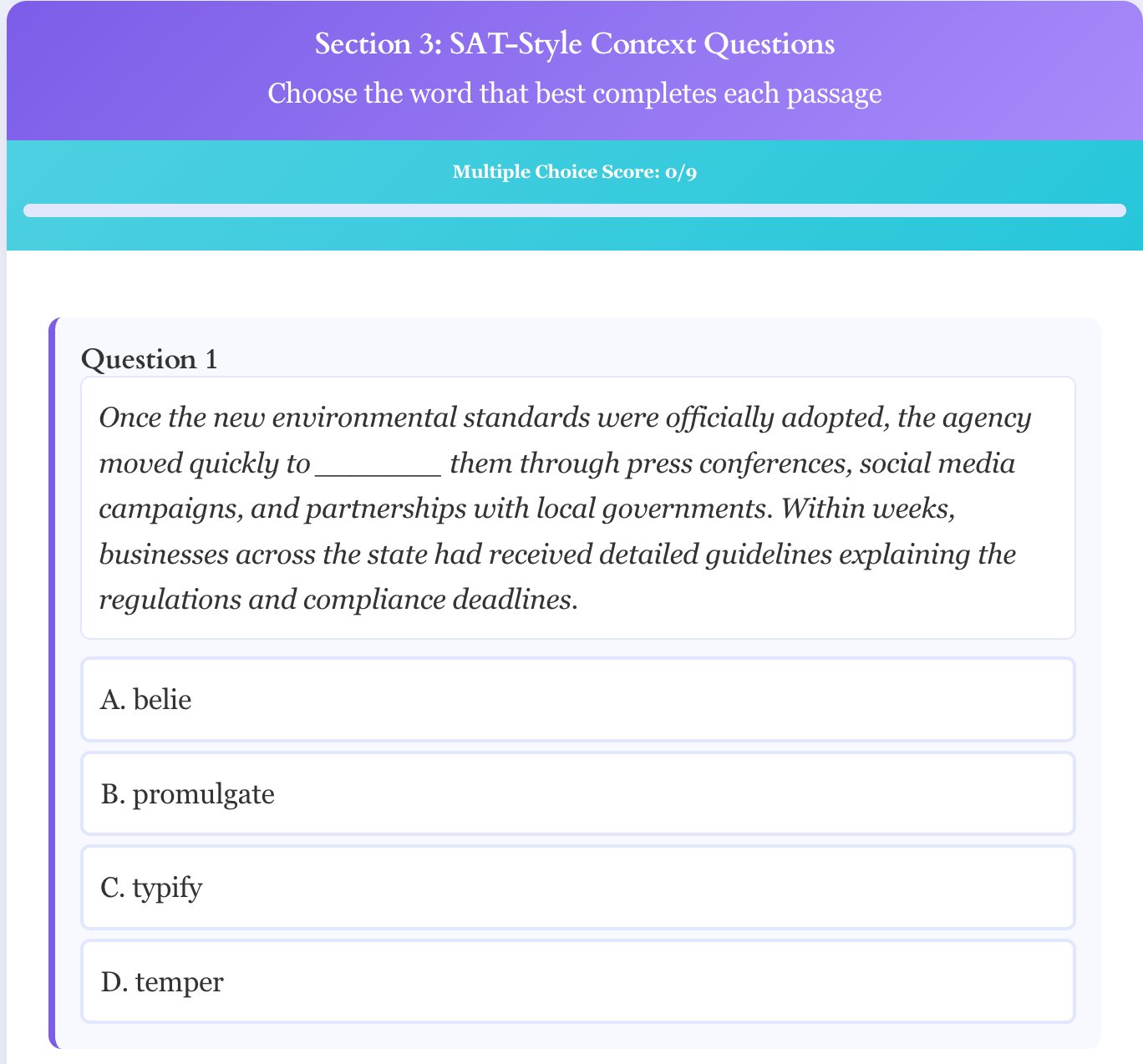
Access our full vocabulary quiz library with flashcards, matching exercises, and SAT-style context questions for every test administration analyzed in this report.
Last updated: January 2026 | Data covers March 2024 - December 2025 SAT administrations