
The PSAT/NMSQT Explained: The Condensed, Parent-Friendly Roadmap for the Class of 2027


Your step-by-step roadmap from PSAT test day to scholarship winner
Table of Contents
- Introduction: Why This Guide Matters
- Understanding the PSAT/NMSQT Test Format
- Digital Testing with Bluebook: What Students Need to Know
- Test Day Preparation Checklist
- Testing Accommodations and English Learner Support
- The Complete National Merit Timeline: 18 Months at a Glance
- Understanding Your Score Report
- The Four Levels of National Merit Recognition
- Deep Dive: The Three Types of National Merit Scholarships
- National Merit Scholarship Sponsors: Who's Offering Awards?
- The Finalist Application Process: A Complete Walkthrough
- Official PSAT Practice Resources
- BigFuture School App and College Connections
- Frequently Asked Questions
- Final Thoughts and Next Steps
Introduction: Why This Guide Matters
Every October, over 3 million high school students sit down to take the PSAT/NMSQT. While many view it as simply a "practice SAT," savvy students and parents know better. The PSAT is actually the gateway to one of America's most prestigious academic recognition programs—and potentially tens of thousands of dollars in college scholarships.
The National Merit Scholarship Program, now in its 71st year, honors approximately 50,000 academically talented high school students annually. Of those, roughly 7,590 students will receive Merit Scholarship awards worth nearly $26 million combined.
This guide walks you through everything the official Student Guide contains—condensed and clarified for busy students and parents. We'll cover the test format, digital testing logistics, the complete 18-month competition timeline, scholarship types, sponsor information, and much more.
Understanding the PSAT/NMSQT Test Format
The PSAT/NMSQT uses a multistage adaptive testing design, meaning the test adjusts its difficulty based on how you perform. Each section contains two modules, and your performance on the first module determines the difficulty mix of the second module.
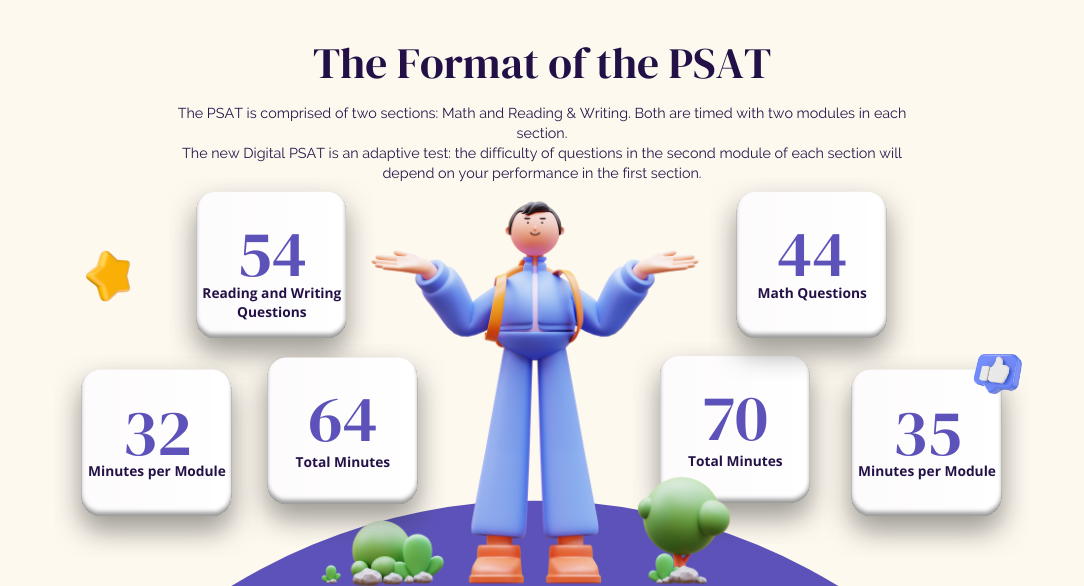
Test Structure at a Glance
| Section | Time | Questions | Time Per Question |
|---|---|---|---|
| Reading and Writing | 64 minutes | 54 questions | ~1.19 minutes |
| Math | 70 minutes | 44 questions | ~1.59 minutes |
| Total | 134 minutes | 98 questions | — |
Reading and Writing Section Breakdown
The Reading and Writing section tests your ability to comprehend, analyze, and revise written content. Questions are based on short passages from literature, history/social studies, humanities, and science—with one question per passage.
| Content Domain | What It Tests | Question Count |
|---|---|---|
| Craft and Structure | Vocabulary in context, text purpose, cross-text connections | 13–15 questions |
| Information and Ideas | Central ideas, evidence analysis, inferences | 12–14 questions |
| Standard English Conventions | Grammar, punctuation, sentence structure | 11–15 questions |
| Expression of Ideas | Rhetorical effectiveness, transitions | 8–12 questions |
Math Section Breakdown
The Math section covers algebra, advanced math, problem-solving with data, and geometry/trigonometry. About 30% of questions are word problems set in real-world contexts.
| Content Domain | What It Tests | Question Count |
|---|---|---|
| Algebra | Linear equations, inequalities, systems of equations | 13–15 questions |
| Advanced Math | Quadratic, exponential, polynomial, and nonlinear functions | 12–14 questions |
| Problem-Solving and Data Analysis | Ratios, percentages, statistics, probability | 7–9 questions |
| Geometry and Trigonometry | Area, volume, triangles, right triangle trig | 4–6 questions |
The Math section includes both multiple-choice and student-produced response (grid-in) questions. A built-in Desmos calculator is available throughout the entire Math section, or you can bring your own approved calculator.

Digital Testing with Bluebook: What Students Need to Know
The PSAT/NMSQT is administered digitally through College Board's custom testing application called Bluebook. Understanding how Bluebook works before test day can significantly reduce test-day anxiety.
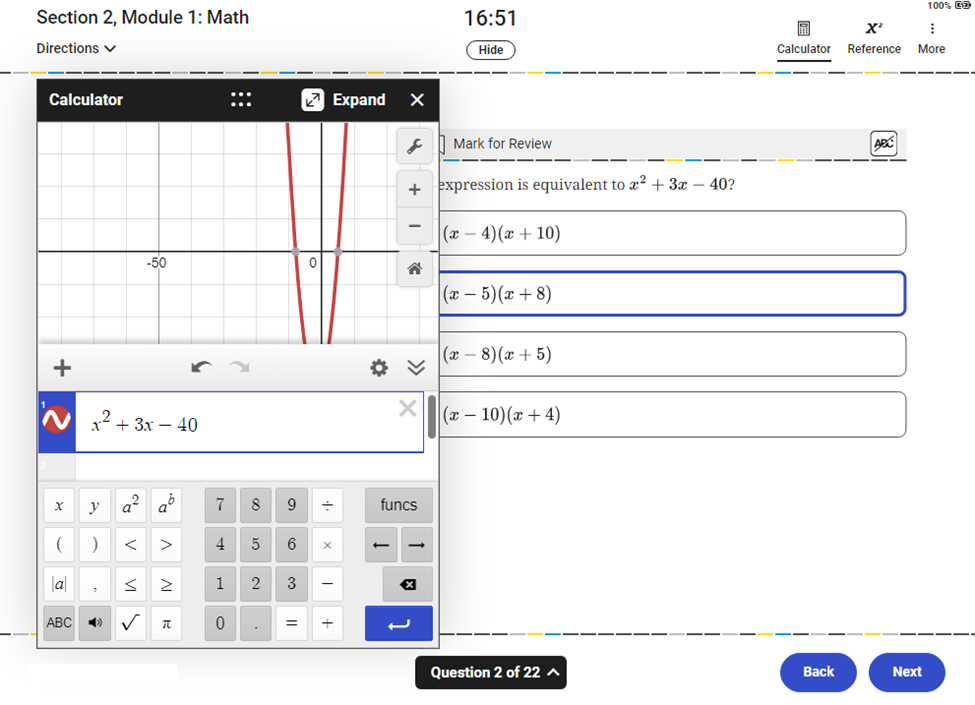
Key Bluebook Features
Navigation Tools:
- Mark for Review: Flag questions to revisit later within your current module
- Question Menu: See which questions you've skipped or marked
- Testing Timer: Counts down remaining time (can be hidden until last 5 minutes)
Answer Tools:
- Option Eliminator: Cross out answer choices you've ruled out
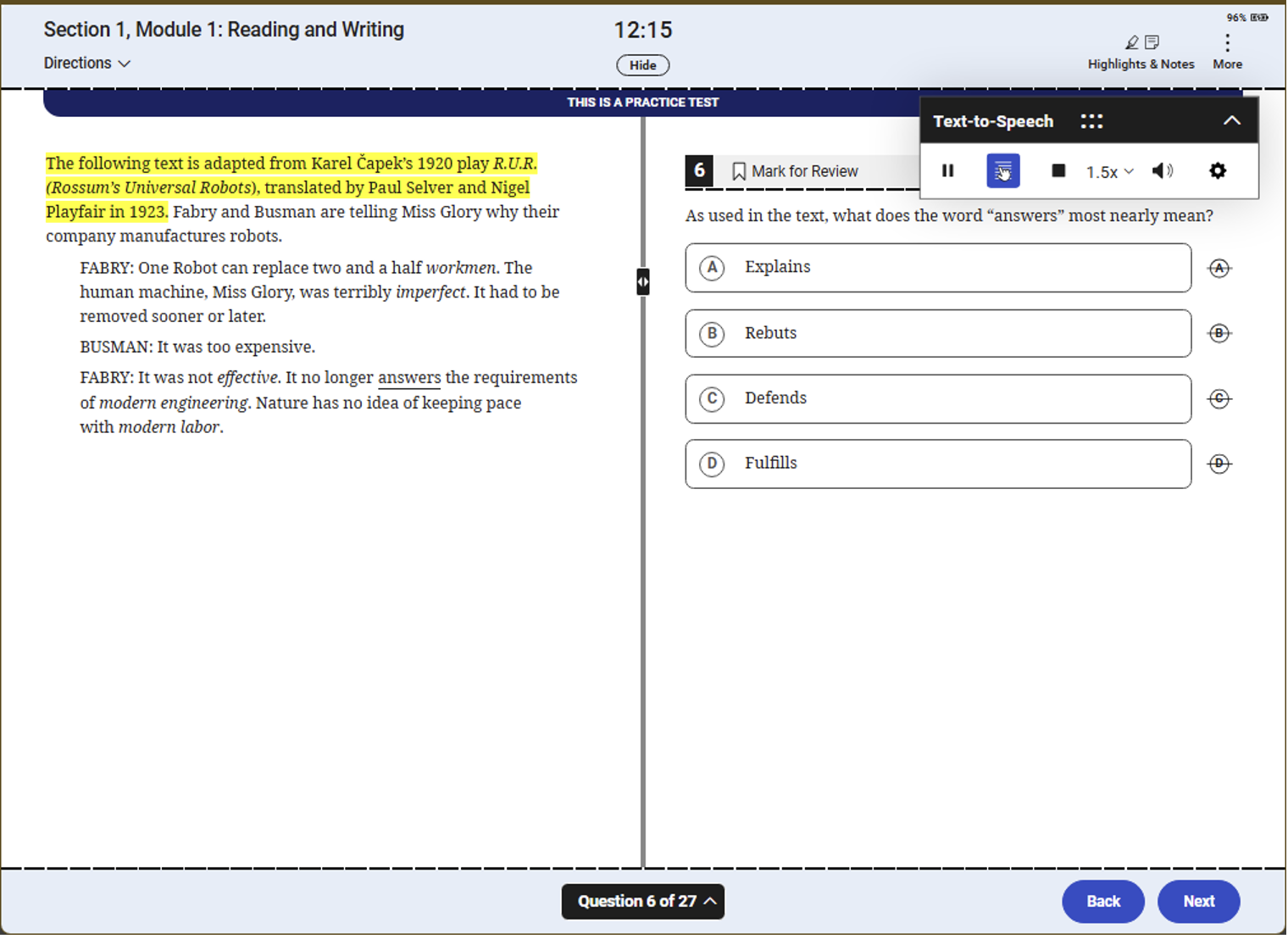
- Highlights & Notes: Highlight passage text and add personal notes (Reading/Writing only)
- Line Reader: Focus tool for reading test content
Math Tools:
- Built-in Desmos Calculator: Available for the entire Math section
- Reference Sheet: Common formulas accessible during Math section
What Happens If Technology Fails?
Bluebook is designed to handle common technical issues:
- Internet drops: The app keeps running; you won't lose work
- Battery dies: Plug in, restart, and pick up where you left off—your work is saved
- App crashes: Relaunch Bluebook, click "Resume Testing," and continue from your last question
At the end of the test, you must be connected to the internet to submit your answers. Do not close your laptop lid or turn off your tablet until testing staff confirm your test has been submitted.
Test Day Preparation Checklist
Being well-prepared for test day eliminates unnecessary stress. Here's your complete checklist:
Required Items
| Item | Notes |
|---|---|
| Testing device | Fully charged, with Bluebook downloaded and exam setup complete |
| Pen or pencil | For scratch work (doesn't need to be No. 2) |
| Photo ID | Only required if testing at a different school (Away Students) |
Recommended Items
| Item | Notes |
|---|---|
| Power cord or portable charger | No guarantee of outlet access |
| Approved calculator | If you prefer your own over the built-in Desmos |
| Extra batteries | For your calculator |
| Snacks and drinks | Must stay under your desk during testing |
| External mouse | Allowed for your testing device |
What NOT to Bring
- Mobile phones or smartwatches (must be stored away)
- Earbuds, headphones, or ear plugs
- Smart pens, Apple Pencils, or styluses
- Books, notes, or reference materials
- Watches that beep or have alarms
- Detachable privacy screens
The Day Before
- Confirm your testing location and start time with your school
- Charge your testing device to 100%
- Verify Bluebook is installed and exam setup is complete
- Get a good night's sleep (8+ hours recommended)
- Prepare your test day items the night before
Test Day Morning
- Eat a balanced breakfast with protein
- Arrive at your testing room early
- Store prohibited items before entering
- Connect to school Wi-Fi as directed
- Complete exam check-in in Bluebook
Testing Accommodations and English Learner Support
College Board provides accommodations for students with documented disabilities and support for English learners.
Requesting Accommodations
Work with your school's SSD (Services for Students with Disabilities) coordinator to request accommodations at least seven weeks before your test date. Common accommodations include:
- Extended time (time and one-half, double time, or more)
- Extra breaks
- Screen reader or text-to-speech
- Large print (zoom feature in Bluebook)
- Permission to test blood sugar
- Small group testing
- Food/drink/medication access
English Learner Support
If you're a non-English proficient or limited-English proficient student, supports available include:
- Word-to-word dictionaries (bilingual glossaries)
- Translated test directions
- Extended time
Work with your school counselor to arrange EL support before test day.
The Complete National Merit Timeline: 18 Months at a Glance
The National Merit competition spans approximately 18 months from entry to scholarship awards. Here's the complete timeline for the 2027 competition:
Year 1: Junior Year (2026-2027)
| When | What Happens |
|---|---|
| October 2026 | Take the PSAT/NMSQT (testing window: October 1-31) |
| November-December 2026 | Scores released in three waves |
| April 2027 | NMSC sends list of 50,000 high scorers to high schools for eligibility verification |
Year 2: Senior Year (2027-2028)
| When | What Happens |
|---|---|
| Early September 2027 | ~16,000 Semifinalists notified through their schools |
| Late September 2027 | ~34,000 Commended Students notified |
| Early October 2027 | Semifinalist application deadline (typically around October 8) |
| November 2027 | Special Scholarship candidates receive application materials |
| December 2027 | SAT/ACT confirming scores due to NMSC (December 31 deadline for full consideration) |
| February 2028 | ~15,000 Finalists notified; receive Certificates of Merit |
| March 2028 | National Merit Scholarship winners begin to be announced |
| April-July 2028 | Additional scholarship winners announced in waves |
| September 2028 | Scholarship payments begin for college enrollment |
Understanding Your Score Report
When your PSAT scores are released, you'll receive several different scores. Here's what each means:
Score Types Explained
| Score Type | Range | What It Measures |
|---|---|---|
| Reading and Writing Section Score | 160-760 | Performance on all R&W questions |
| Math Section Score | 160-760 | Performance on all Math questions |
| Total Score | 320-1520 | Sum of both section scores |
| NMSC Selection Index | 48-228 | Used for National Merit consideration |
The Selection Index Formula
The Selection Index is what NMSC uses to identify program qualifiers. It's calculated as:
(Reading & Writing Score × 2) + Math Score) ÷ 10 = Selection Index
Notice that the Reading and Writing score is doubled—this means strong verbal skills carry extra weight in National Merit qualification.
Accessing Your Scores
You can view your scores through:
- BigFuture School mobile app (if you provided your phone number during testing)
- College Board student account (studentscores.collegeboard.org)
- Your school counselor (official score reports)
Your score report also includes a Career Insights Snapshot showing growing careers in your state that connect to your demonstrated skills.
The Four Levels of National Merit Recognition
Not all 50,000 high-scoring students receive the same recognition. Here's how the levels break down:
Level 1: Commended Students (~34,000 students)
Students who score at or above the national Commended Student cutoff (typically around 207-211 Selection Index) receive Letters of Commendation. While Commended Students don't advance in the Merit Scholarship competition, they:
- Receive formal recognition of academic achievement
- May qualify for Special Scholarships from corporate sponsors
- Can list this honor on college applications
- Stand out to admissions officers
Level 2: Semifinalists (~16,000 students)
Semifinalists are the highest-scoring entrants in each state, representing less than 1% of each state's high school seniors. Semifinalist cutoffs vary by state—from around 210 in some states to 225 in the most competitive states.
To become a Semifinalist, you must:
- Score at or above your state's cutoff
- Meet all program entry requirements
- Be progressing normally toward graduation
Level 3: Finalists (~15,000 students)
About 95% of Semifinalists advance to Finalist standing. To qualify as a Finalist, you must:
- Complete the National Merit Scholarship Application
- Have consistently very high academic performance (grades 9-12)
- Be endorsed by your high school principal
- Earn confirming SAT or ACT scores
- Be enrolled in your final year of high school
- Plan to enroll full-time in college the following fall
Level 4: Merit Scholars (~6,930 students)
Merit Scholars are the scholarship winners—selected from the Finalist pool based on their complete application, including essay, activities, academic record, and school recommendation.
Deep Dive: The Three Types of National Merit Scholarships
Approximately half of all Finalists (around 6,930 students) win a National Merit Scholarship. Here's a detailed look at each type:
1. National Merit $2500 Scholarships
| Feature | Details |
|---|---|
| Number Awarded | ~2,500 annually |
| Amount | $2,500 one-time payment |
| Funded By | NMSC's own funds + corporate grants |
| Selection Basis | State-representational; most distinguished credentials |
| College Requirement | None—winners can attend any accredited college |
These scholarships are awarded to Finalists judged by a committee of college admission officers and high school counselors to have the most distinguished credentials and potential for academic success. Financial need, college choice, and intended major are not considered.
2. Corporate-Sponsored Scholarships
| Feature | Details |
|---|---|
| Number Awarded | ~830 annually |
| Amount | Varies ($2,500-$10,000+ per year) |
| Funded By | ~150 corporations and business organizations |
| Eligibility | Often children of employees, community residents, or students with specific career plans |
| Duration | Many are renewable for 4 years |
Corporate sponsors may designate their awards for:
- Children of their employees
- Residents of communities where they operate
- Students with career interests related to their business
- Students meeting other sponsor-specific criteria
3. College-Sponsored Merit Scholarships
| Feature | Details |
|---|---|
| Number Awarded | ~3,600 annually |
| Amount | $500-$2,000+ per year (many offer more) |
| Funded By | ~140 colleges and universities |
| Key Requirement | Must list the sponsoring college as your first choice |
| Duration | Renewable for up to 4 years |
One Scholarship Per Student
No student can receive more than one National Merit Scholarship. If you're eligible for multiple types, you'll receive the one with the highest value.
National Merit Scholarship Sponsors: Who's Offering Awards?
Over 300 organizations sponsor National Merit Scholarships. Here's a comprehensive look at who participates:
Corporate and Business Sponsors (Partial List)
Major corporations funding National Merit awards include:
| Industry | Sample Sponsors |
|---|---|
| Technology | Intel, Microsoft, Qualcomm, NVIDIA, AMD, Dell Technologies |
| Energy | ExxonMobil, Chevron, ConocoPhillips, BP, Shell, Duke Energy |
| Healthcare | Pfizer, Merck, Abbott, UnitedHealth, Johnson & Johnson |
| Financial Services | Goldman Sachs, JPMorgan Chase, Capital One, Northwestern Mutual |
| Consumer Goods | Procter & Gamble, Coca-Cola, General Mills, Kellogg's |
| Manufacturing | Boeing, Caterpillar, 3M, General Motors, Ford |
| Retail | Target, Walmart, Home Depot |
Many corporate scholarships are specifically for children of employees, so check if your parent's employer participates.
College and University Sponsors
Over 140 colleges and universities offer college-sponsored Merit Scholarships. Participating institutions include:
| Category | Examples |
|---|---|
| Large Public Universities | University of Alabama, University of Oklahoma, University of Kentucky, Texas A&M |
| Private Universities | Vanderbilt, University of Southern California, Case Western Reserve |
| Technical Institutions | Harvey Mudd, Rose-Hulman, RIT |
| Liberal Arts Colleges | Carleton, Grinnell, Oberlin |
Individual Donors
The NMSC President's Fund receives donations from individuals who support academic excellence, providing additional funding for National Merit $2500 Scholarships.
The Finalist Application Process: A Complete Walkthrough
If you're named a Semifinalist, you'll need to complete a comprehensive application to advance to Finalist standing. Here's exactly what's involved:
The Online Scholarship Application (OSA)
The application is completed through NMSC's Online Scholarship Application portal. It has two parts:
Student Section:
- Personal essay (responding to a specific prompt)
- Activities list (extracurriculars, leadership roles, awards)
- Employment history
- Biographical information
- First-choice college selection
School Section (completed by your counselor):
- Academic record verification
- Course rigor assessment
- Principal's endorsement and recommendation
- Confirmation of graduation timeline
The Semifinalist Essay
The essay is your opportunity to share something meaningful about yourself that grades and scores don't capture. While prompts may vary, they typically ask you to describe:
- Significant experiences or achievements
- Your goals and aspirations
- What makes you unique
Confirming SAT or ACT Scores
You must take either the SAT or ACT and have official scores sent to NMSC. Key requirements:
| Requirement | Details |
|---|---|
| Test Options | SAT or ACT (your choice) |
| Score Report Deadline | December 31 of senior year (for full consideration) |
| Final Receipt Deadline | January 31 of senior year |
| How to Send | Request official score report through College Board or ACT |
| NMSC Code | Use NMSC's designated code when sending scores |
The confirming score should demonstrate performance consistent with your PSAT/NMSQT—dramatic discrepancies may raise questions about your candidacy.
Application Timeline
| Date | Action Item |
|---|---|
| Early September | Receive Semifinalist notification through your school |
| September | Access OSA and begin application |
| Early October | Application deadline (typically around October 8) |
| October-November | Take SAT or ACT if you haven't already |
| December 31 | SAT/ACT scores due to NMSC for full consideration |
| February | Finalist notifications sent |
Official PSAT Practice Resources
College Board provides extensive free resources to help you prepare:
Bluebook Practice Tests
Full-length adaptive practice tests are available directly in the Bluebook app. These tests:
- Mirror the actual test experience
- Include all question types you'll encounter
- Provide adaptive second modules based on your performance
- Generate practice scores
To access: Download Bluebook → Go to Practice and Prepare → Select Full-Length Practice
Khan Academy SAT Prep
While branded for the SAT, Khan Academy's free preparation applies directly to the PSAT/NMSQT since both tests share the same content and format.
Available resources:
- Video lessons explaining concepts
- Practice questions by skill
- Personalized practice recommendations
- Full-length practice tests
Visit: khanacademy.org/digital-sat
Student Question Bank
Design your own practice sessions with College Board's question bank featuring thousands of official questions. Filter by:
- Section (Reading & Writing or Math)
- Content domain
- Specific skill
- Difficulty level
Access through: mypractice.collegeboard.org
Question of the Day
Build a daily practice habit with official questions delivered to your phone or computer.
Visit: qotd.collegeboard.org
BigFuture School App and College Connections
College Board offers tools to help you plan beyond the PSAT through the BigFuture School mobile app.
What BigFuture School Offers
If you're 13 or older and tested in the United States, you can:
- View your PSAT scores instantly when released
- Access your Career Insights Snapshot
- Take the Career Quiz to explore career paths
- Receive personalized college and career planning messages
To set up: Provide your mobile number during exam setup, and you'll receive a text with download instructions.
Connections: College Matching Service
Connections is an optional, free program that matches you with:
- Nonprofit colleges and universities (domestic and international)
- Scholarship providers
- Government educational programs
How it works:
- Opt in during testing or in the BigFuture app
- Organizations see anonymized profiles of students matching their criteria
- You receive information about schools and scholarships that might fit
- Some colleges may send preliminary admission offers
What colleges see: Grade level, test score ranges, geographic location, intended major, and other factors you choose to share. Your personal contact information is NOT shared.
Note: Preliminary admission offers through Connections may require additional steps to complete enrollment. They're not guaranteed acceptances but can streamline your application process at interested schools.
Frequently Asked Questions
Test-Related Questions
Q: Can I take the PSAT more than once? A: You may only take the PSAT/NMSQT once during each annual testing window. However, your sophomore year PSAT doesn't count for National Merit—only your junior year test qualifies you for the competition.
Q: What if I'm sick on test day? A: Contact your school immediately. You may be able to test on a different day within the October testing window, or test at a nearby school with a different date. If the testing window has closed, contact NMSC before April 1 to request an alternate entry route.
Q: Can I use my own calculator? A: Yes, if it's on the approved list. Check collegeboard.org/psat-calculator for acceptable calculators. You can also use the built-in Desmos calculator in Bluebook.
National Merit Questions
Q: Do Commended Students receive any scholarships?
A: Commended Students don't receive National Merit Scholarships, but they may be eligible for Special Scholarships from corporate sponsors who have their own eligibility criteria.
Q: What if I'm homeschooled?
A: Homeschooled students can participate fully. Make arrangements to take the PSAT at a local school, and if you qualify for recognition, NMSC will send notifications to your home address.
Q: Does my PSAT score affect college admissions?
A: Colleges do not see your PSAT scores unless you choose to share them. However, National Merit recognition (Commended, Semifinalist, Finalist, Scholar) is a significant credential that can strengthen applications and unlock scholarships.
Q: What's a "confirming" SAT/ACT score?
A: It's an SAT or ACT score that demonstrates performance consistent with your PSAT. There's no published minimum, but significant discrepancies between your PSAT and confirming test may affect your Finalist candidacy.
For questions about Selection Index calculations and state cutoff scores, see our comprehensive PSAT/NMSQT guide.
Final Thoughts and Next Steps
The National Merit Scholarship Program rewards academic excellence with both recognition and substantial financial awards. Whether you're just beginning to prepare for the PSAT or anxiously awaiting your Semifinalist notification, understanding the complete process helps you maximize your opportunities.
For Sophomores and Rising Juniors
- Start preparing early — The PSAT matters more than most students realize
- Practice with official materials — Use Bluebook and Khan Academy resources
- Focus on Reading & Writing — It's worth double in the Selection Index
- Know your state's cutoff range — Set realistic but ambitious goals
For Current Juniors Taking the PSAT
- Complete exam setup in Bluebook before test day
- Get plenty of sleep the night before
- Use all available time on each module
- Don't stress — do your best and know that one test doesn't define you
For Semifinalists
- Start your application immediately — don't wait until the deadline
- Take the SAT or ACT if you haven't — confirming scores are required
- Craft a compelling essay — this differentiates you from other high scorers
- Research college-sponsored scholarships — some offer incredible packages for Finalists
Ready to Achieve Your Best PSAT Score?
At Mr. John's Test Prep, we specialize in helping students maximize their PSAT performance and National Merit potential. Our proven approach has helped multiple students qualify as National Merit Semifinalists and Finalists—including a student who achieved a perfect PSAT score.
Learn more about working with Mr. John
Information in this guide is based on the official Fall 2025 PSAT/NMSQT Student Guide published by College Board and National Merit Scholarship Corporation. Program details, deadlines, and requirements may change. Always confirm current information with your school counselor and visit nationalmerit.org for the most up-to-date official information.
Related Resources: