
How to Prepare for the Upcoming SAT/PSAT the Right Way


Through my work with students preparing for the SAT and PSAT, I’ve noticed a similar pattern repeating. They start strong. Motivation is high, the schedule is fresh, and the early practice tests feel exciting. Then, a few weeks in, the rhythm fades off. The effort is still there, but progress slows, and everything starts to feel random again.
When that happens, it’s rarely about intelligence or effort. It’s about how you’re training. Studying for the SAT isn’t just about learning grammar rules or memorizing formulas. It’s about learning to think and move at the right pace — to recognize patterns, eliminate ambiguity, and prove every answer before you choose it.
That’s the mindset I teach my students from the first week. You don’t need to study harder. You need to study with rhythm, awareness, and control.
Here’s how I help them prepare for the SAT or PSAT the right way.
Why Most SAT/PSAT Study Plans Stop Working
I’ve watched this pattern play out hundreds of times. A student builds a detailed study plan, sticks with it for a few weeks, and then hits a wall. The effort is still there, but the results stop moving.
If you’ve ever felt like you’re putting in the work and not seeing your score change, you’re not alone — and there’s a reason for it.
Most students track time instead of progress. They measure how long they study, not what they learn from each session. That’s why I always tell my students: the hours don’t matter if you’re not learning from them.
Here’s what usually happens:
- Too many hours, not enough review. You take a practice test, glance at your score, and move on. That isn’t learning.
- Too much content, not enough pattern recognition. You study rules and formulas, but don’t notice how the SAT repeats the same traps.
- Too much effort, not enough feedback. You keep practicing, but never slow down long enough to fix what caused the mistakes.
When your preparation looks like that, it can feel like running on a treadmill. You’re moving, but not going anywhere.
The problem isn’t the effort — it’s what’s missing between each study session. That’s where consistency and feedback start to matter most.
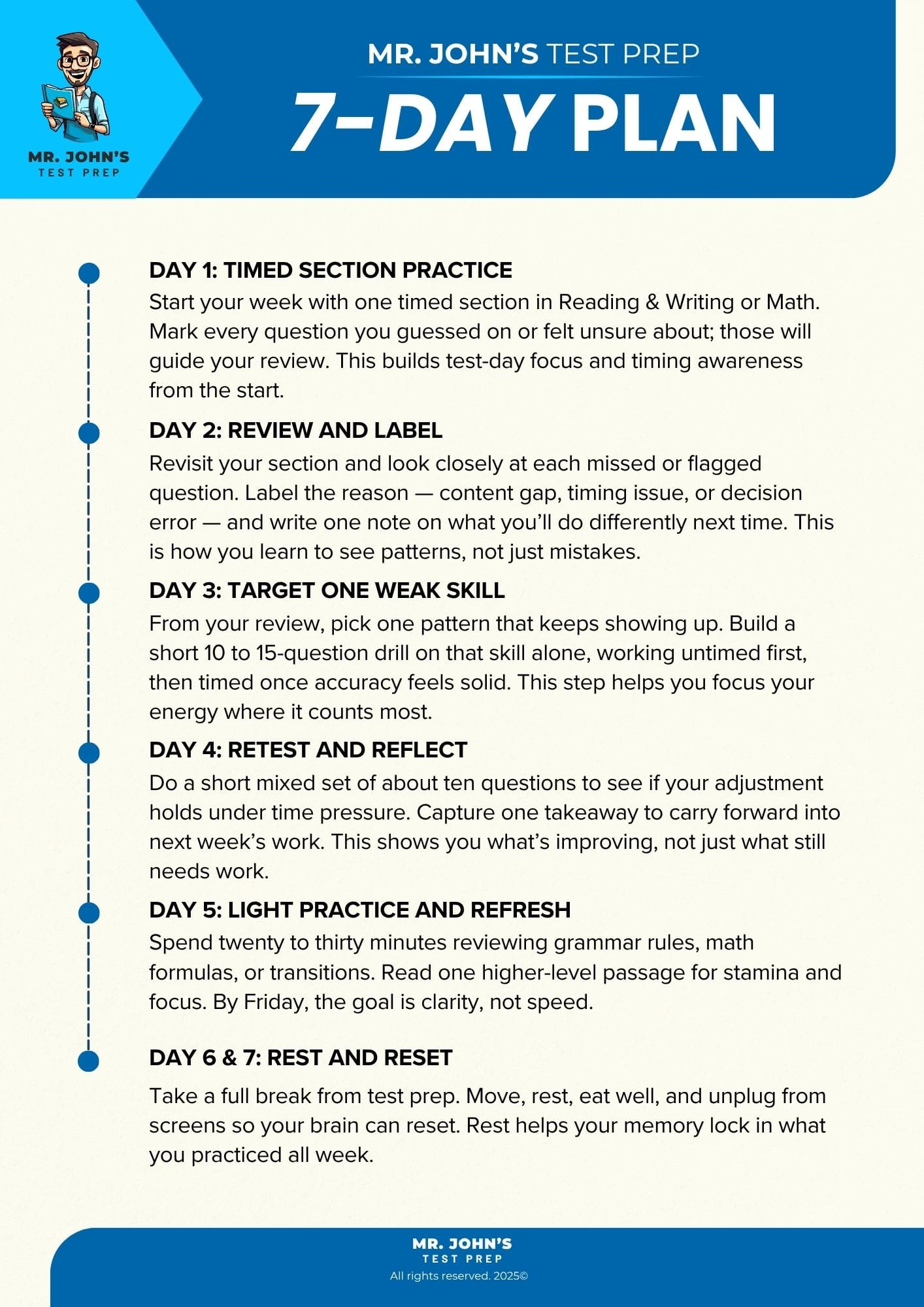
How Should You Structure Your SAT Practice Each Week?
The goal is not seven days of study. It is a steady rhythm you can repeat. Short, focused blocks build accuracy and confidence without burnout. Plan on 30 to 60 minutes per block. If you are preparing for the PSAT, use 30 minutes.
How to Stop Second-Guessing on the SAT
One of the biggest score killers on the SAT and PSAT isn’t what you don’t know — it’s second-guessing what you already do. Many students change correct answers to wrong ones because they can’t explain why their first choice works. The solution isn’t more studying. It’s learning to make choices you can prove.
Why You Keep Changing Right Answers
When you’re under time pressure, confidence fades fast. You start rereading the same lines, looking for something new that isn’t there. Most wrong answers come from three habits:
- Feeling instead of proving. Picking what “sounds right” without checking the evidence.
- Overanalyzing traps. Assuming every answer is a trick.
- Changing without reason. Switching just because you feel unsure.
The SAT isn’t testing how clever you sound. It’s a test of your critical thinking. Every right answer can be proven.

How to Prove Your Answers
When you face a question, take a breath before making a choice. Ask yourself: “Can I prove this?” That single question keeps your thinking grounded.
Reading and Writing
- Find a line reference that supports your answer. If you can’t point to one, it’s not the best choice.
- Check scope — the correct answer stays within the exact idea of the question.
- For example, if the question asks for evidence that a species is endangered, your proof must mention population decline, not general threats.
- Before moving on, tell yourself, “This line proves my choice.”
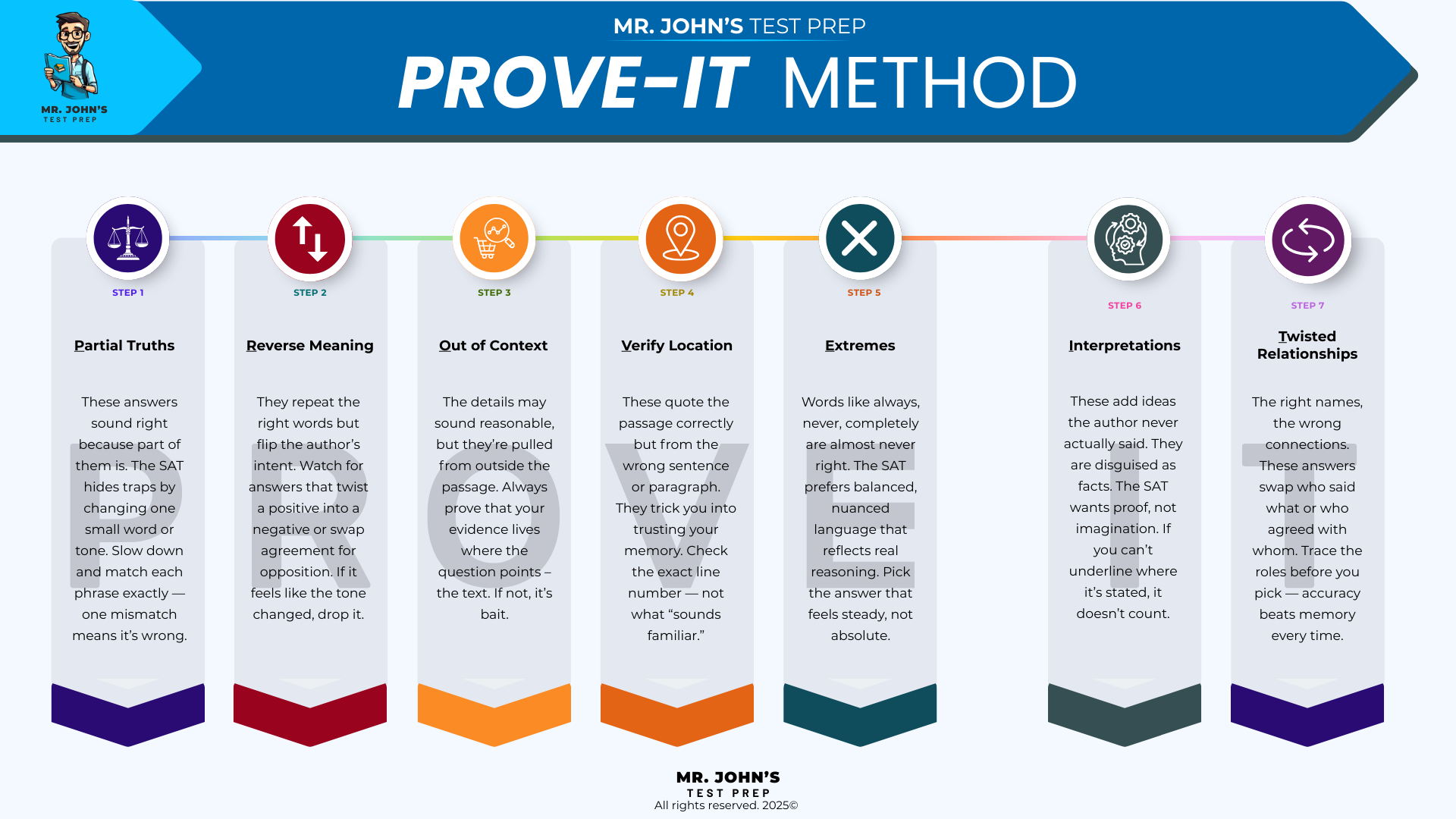
The same logic applies when setting up the question itself. I teach students to slow down and think like the test maker, using a simple process like the PROVE-IT Method or the ISEE technique.
Math
- Plug your answer back into the original equation or context.
- Check units and scale. If you’re solving for distance but get seconds, something’s off.
- Make sure the result makes sense — rates shouldn’t be negative if time and distance are positive.
If you can’t find proof within about fifteen seconds, skip and mark it. When you return later with a clear head, the right logic will still make sense — forced reasoning never does. This simple SAT answer strategy replaces guessing with proof.

Ready to Build your SAT Plan?
Every strong SAT or PSAT score starts with consistency, proof, and reflection. If you can study in short, steady blocks, make decisions you can justify, and review your mistakes honestly, your score will rise. There’s no secret to it — just clear strategy and commitment.
You’ve already done the hard part by starting. Now it’s about execution — one calm, focused session at a time.
If you’d like a tutor to walk through your latest practice test with you, label your patterns, and create a plan that fits your goals, I’d be happy to help. You can visit MrJohnTestPrep.com to get started.
Common Questions About SAT and PSAT Prep
1. How do I start preparing for the SAT if I have no idea where to begin?
Start small. Pick one section, Reading & Writing or Math, and take a short timed set to see where you stand before planning the rest.
2. How many hours a week should I study for the SAT or PSAT?
Four to five focused study blocks of 30 to 60 minutes a week are enough when done consistently. Quality beats cramming every time.
3. What’s the best way to review SAT mistakes?
Go through every missed question and ask why: content gap, timing issue, or decision error. Fix one pattern at a time instead of reviewing everything.
4. Can I raise my SAT score in a month?
Yes, if you already know most of the content and focus on performance. I usually recommend short, targeted drills instead of full-length tests every day. My students are averaging 60-70 points increase in the Reading and Writing section alone.
5. Should I study for the PSAT and SAT differently?
Not really. The PSAT uses the same skills and structure, so the same study rhythm you use for the SAT will help you score higher on both.
6. What if I keep getting the same SAT score on every practice test?
It usually means your review process needs work, not your knowledge. I teach my students to log, label, and fix repeating mistake patterns before moving to another test.
7. Is it worth getting an SAT tutor?
If you’re stuck, a tutor can save weeks of guessing what to fix next. I go through students’ tests question by question to find exactly where points are being lost.