
How to Read Your SAT Score Report: Understanding Domains, Skills, and What to Study Next
A real student's question reveals what most families don't understand about SAT score reports.

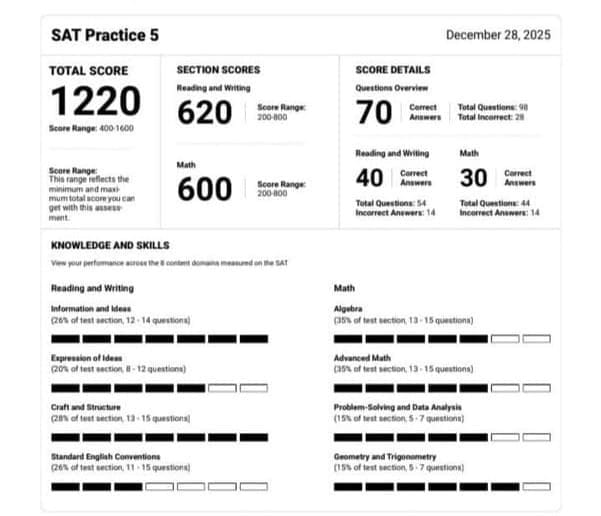
A student recently posted in an SAT prep Facebook group with a question that perfectly captures the confusion many families experience when looking at their SAT results:
"Which stuff do I practice? I didn't understand how my results looked. I'm really confused because the part I did well said hard and the part I didn't perform well said easy..."
This student had just completed SAT Practice Test 5 in the College Board's Bluebook app and scored a 1220—a solid starting point. But like thousands of other students and parents across the country, they were staring at progress bars and percentages without any clear sense of what it all meant or what to do next.
If you've ever felt the same way looking at your own score report, you're not alone. In this guide, we'll break down exactly what SAT "domains" are, what the progress bars actually tell you, and most importantly, how to use this information to build a targeted study plan that will actually raise your score.
What Are SAT Content Domains?
The Digital SAT is organized into eight content domains—four for the Reading and Writing section and four for the Math section. Think of domains as broad categories that group related skills together. Each domain represents a specific area of knowledge that the College Board has determined is "essential for college and career readiness."
Understanding these domains is crucial because your score report breaks down your performance by domain, not by individual questions. This gives you a roadmap showing where you're strong and where you need improvement.
Reading and Writing Domains
The Reading and Writing section (scored 200-800) contains 54 questions spread across these four domains (in actual order of typical appearance as you move linearly through the modules:
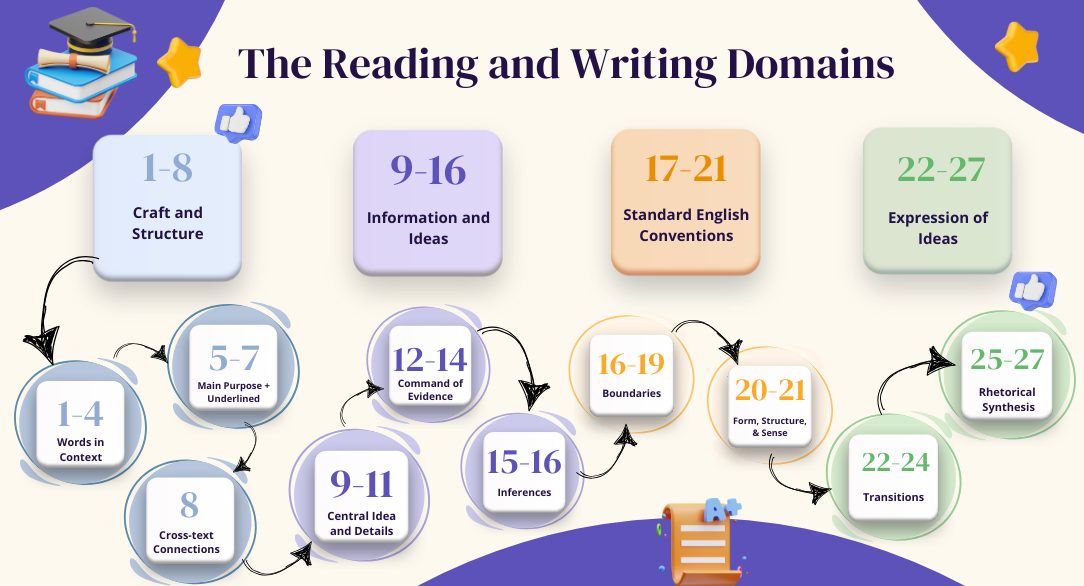
Craft and Structure (28% of section, approximately 13-15 questions)
This domain focuses on vocabulary in context, understanding how texts are structured, the purpose of the text, and making connections between related passages. These questions require you to understand not just what an author is saying, but how or why they're saying it.
Skills tested: Words in Context, Text Structure and Purpose, Cross-Text Connections
Information and Ideas (26% of section, approximately 12-14 questions)
This domain measures your ability to comprehend and analyze texts, including locating and integrating information from both written passages and informational graphics like tables and charts.
Skills tested: Central Ideas and Details, Inferences, Command of Evidence (Textual and Quantitative)
Here's an example of a Quantitative Command of Evidence question you might see on test day:
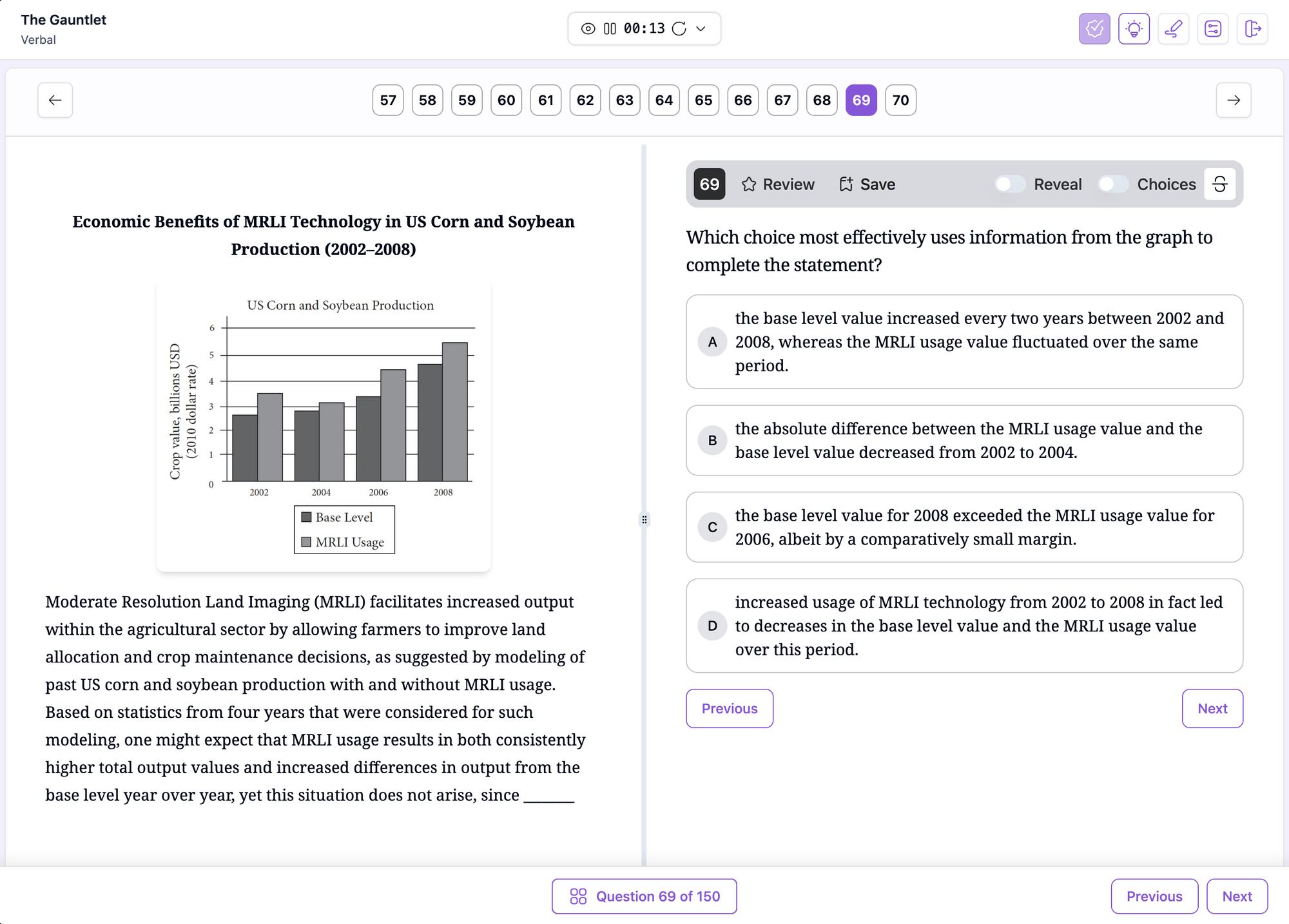
Standard English Conventions (26% of section, approximately 11-15 questions)
Grammar, punctuation, and sentence structure live here. If you mix up semicolons and commas or struggle with subject-verb agreement, this domain will reveal it.
Skills tested: Boundaries and Form, Structure, and Sense
You may be thinking, "what is included in those skills?" And I'm glad you asked. Here are several of the most common skills you'll find tested in what I like to call "Grammar Land."
- Subject-Verb Agreement
- Non-finite Verbs
- Verb Tenses
- IC-IC (Independent Clause + Independent Clause)
- IC-DC (Independent Clause + Dependent Clause)
- Non-essentials (comma/dash usage)
- Boundaries + Transitions
- Modifiers
- Title + Name punctuation
- Who, That, Which
- Possessives
- Pronouns
- Colons
- Complex Lists (semicolons)
- Questions
Expression of Ideas (20% of section, approximately 8-10 questions)
This domain measures your editing skills—specifically, your ability to improve written expression by revising sentences to achieve specific rhetorical goals or improve transitions.
Skills tested: Rhetorical Synthesis, Transitions (Continuation, Contrasts, and Cause and Effect)
Math Domains
The Math section (scored 200-800) contains 44 questions spread across these four domains:
Algebra (35% of section, approximately 13-15 questions)
This is the largest math domain, focusing on linear equations, inequalities, functions, and systems of equations.
Skills tested: Linear equations in one/two variables, Linear functions, Systems of linear equations, Linear inequalities
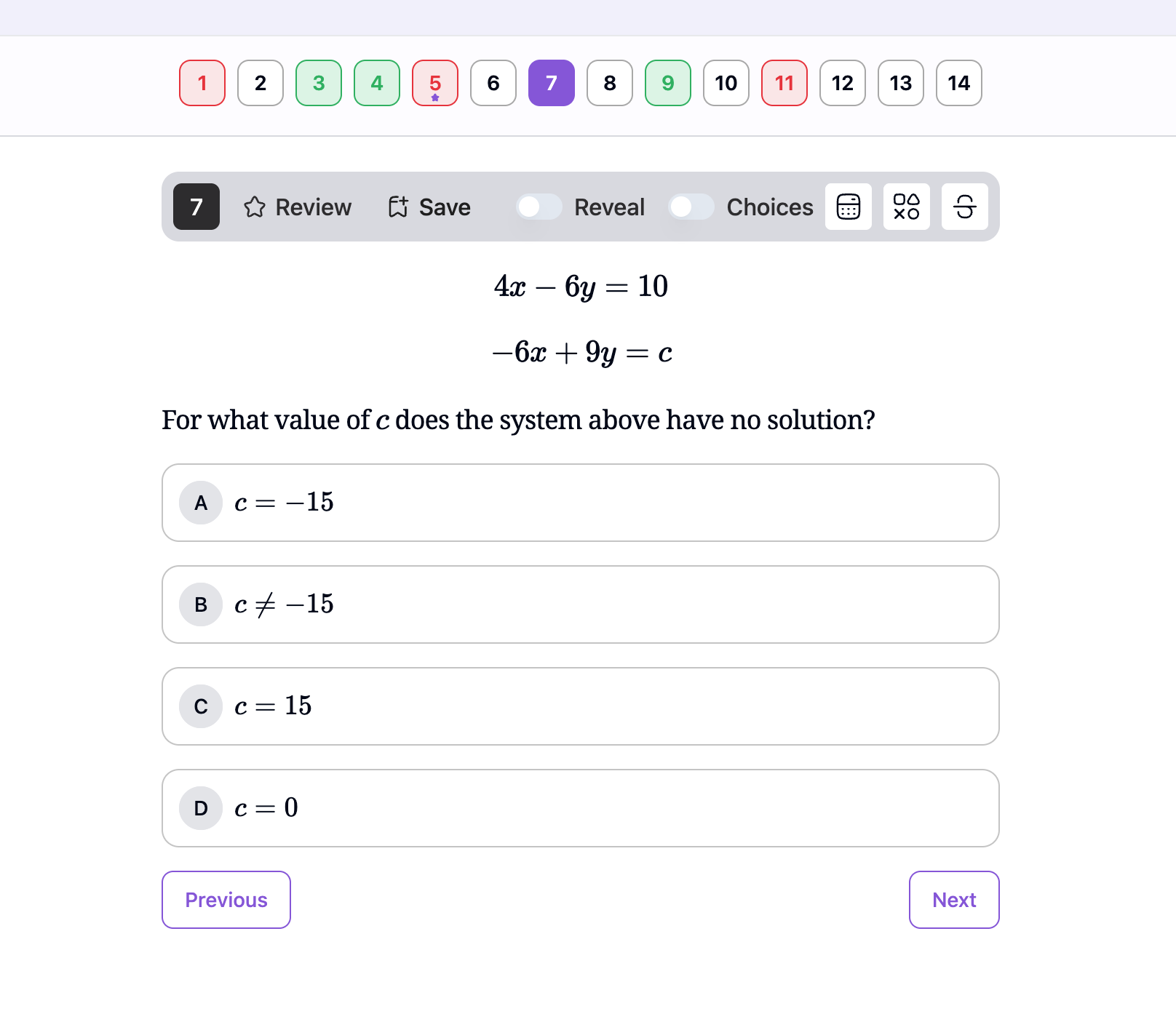
Advanced Math (35% of section, approximately 13-15 questions per module)
Don't let the name intimidate you—this domain covers concepts most students encounter in Algebra 2, including quadratics, polynomials, and exponential functions.
Skills tested: Nonlinear functions, Nonlinear equations, Systems of equations, Equivalent expressions
Problem-Solving and Data Analysis (15% of section, approximately 5-7 questions per module)
This domain tests quantitative reasoning through real-world applications, including ratios, percentages, probability, and statistical analysis.
Skills tested: Ratios and proportions, Percentages, One- and two-variable data analysis, Probability, Statistical inference, Evaluating statistical claims
Geometry and Trigonometry (15% of section, approximately 5-7 questions per module)
The smallest math domain covers area, volume, angles, triangles (including right triangle trigonometry), and circles. While it represents fewer questions, mastering this domain can be an efficient way to pick up points.
Skills tested: Area and volume, Lines/angles/triangles, Right triangle trigonometry, Circles
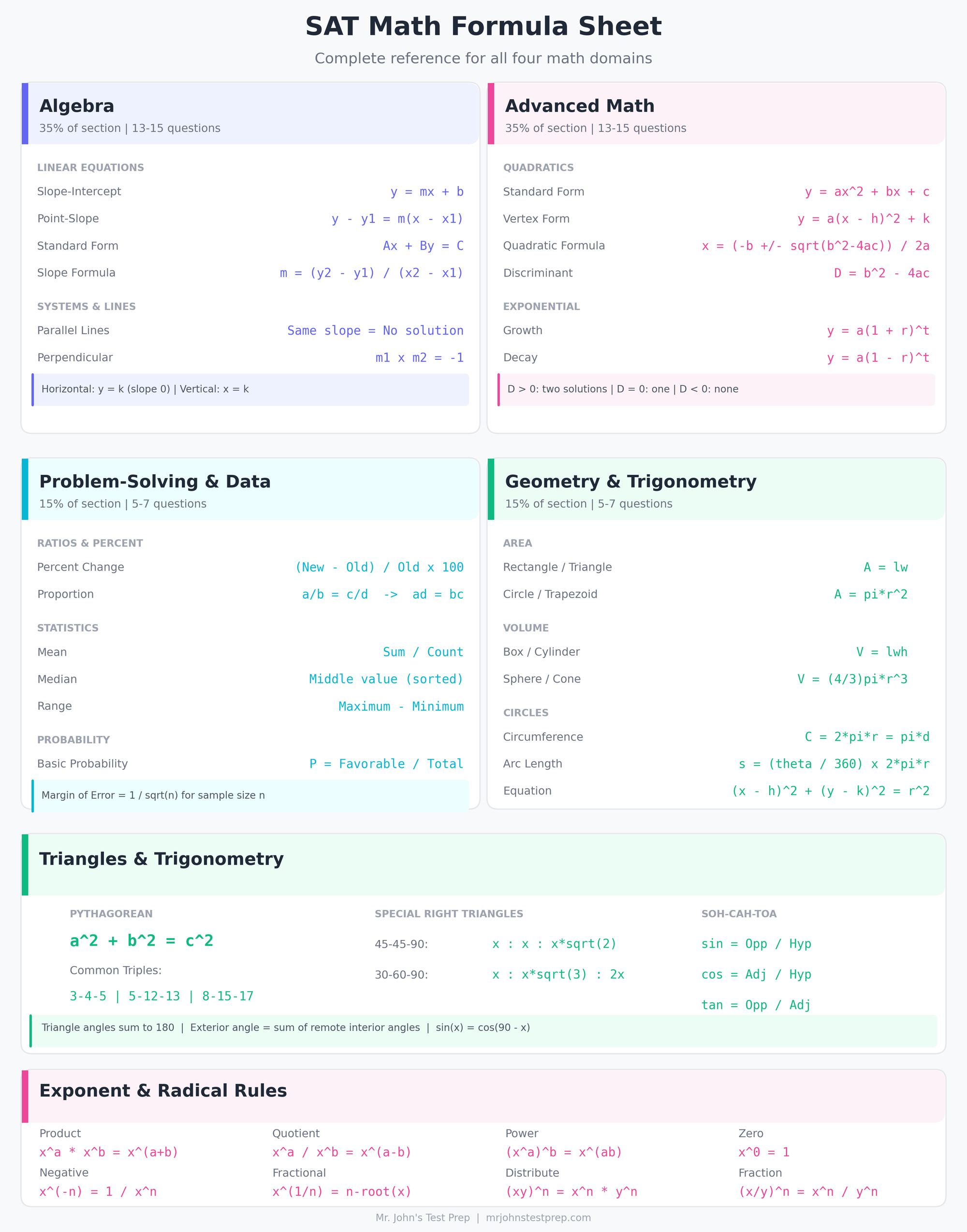
SAT Math Formulas You Need to Know!
Reading Your Score Report: What Those Progress Bars Actually Mean
Let's go back to our confused student. Looking at their score report, they saw progress bars for each domain with varying levels filled in. Next to each domain, they also saw labels like "26% of test section, 12-14 questions." Here's what was causing the confusion.
The progress bars on your practice score report represent your proficiency level in that domain—not the difficulty level of the questions themselves. The bars range from 1 to 7, with more filled bars indicating stronger performance. According to the College Board's official guidance:
- Bars 1-3: You're still learning the foundational skills in this domain
- Bars 4-5: You have solid understanding of basic skills but may struggle with more complex applications
- Bars 6-7: You're well on your way to mastering this domain
The percentage and question count next to each domain tell you how much of the overall section that domain represents. This is crucial information for prioritizing your study time.
Here's the key insight our student was missing: a domain with a higher percentage of questions is worth more attention than one with fewer questions, all else being equal. If you're weak in a domain that represents 35% of the math section, improving there could have a bigger impact on your score than improving in a domain that only represents 15%.
It's also important to know that questions with an "easy" difficulty rating, according to the College Board, will likely cost you more points that difficult questions. Why? Because they expect you to get those right. Miss one, it could cost you 20 points. Miss a hard question, it could cost you 0-10 points. That's a "guestimate," but it's actually true
The Critical Difference: Practice Tests vs. Official SAT Score Reports
Here's something many families don't realize: the information you receive from a Bluebook practice test is significantly more detailed than what you'll receive from the official SAT on test day.
When you take a practice test in Bluebook, you can:
- Review every single question you answered
- See the correct answer for each question
- Read detailed explanations for why each answer choice is correct or incorrect
- Identify patterns in the types of questions you're missing
This question-level data is invaluable for targeted preparation. You can literally click through each question you missed and understand exactly where your reasoning went wrong.
However, when you take the official SAT, your score report will show you:
- Your total score and section scores
- Your performance bands for each domain (similar progress bars)
- The percentage of questions from each domain
What you won't see on the official SAT score report:
- Which specific questions you got wrong
- The actual questions or answer choices
- Detailed explanations
This is why taking full-length Bluebook practice tests is so essential for identifying weaknesses. The practice environment gives you the diagnostic information you need to improve. The official SAT simply tells you how you performed overall—useful for college applications, but not for studying.
A Complete Guide to SAT Skills: What to Study in Each Domain
Now that you understand the domain structure, let's get specific. Below is a comprehensive breakdown of every skill tested within each domain. Use this as a checklist to identify exactly what topics you need to review.

Reading and Writing Skills Breakdown
| Domain | Skill | What It Tests |
|---|---|---|
| Information and Ideas | Central Ideas and Details | Finding main ideas and supporting details in passages |
| Information and Ideas | Inferences | Drawing logical conclusions from text |
| Information and Ideas | Command of Evidence | Using textual and quantitative evidence to support claims |
| Craft and Structure | Words in Context | Understanding vocabulary based on how it's used in passages |
| Craft and Structure | Text Structure and Purpose | Analyzing how and why authors organize their writing |
| Craft and Structure | Cross-Text Connections | Comparing and connecting ideas across multiple passages |
| Expression of Ideas | Rhetorical Synthesis | Combining information to achieve specific writing goals |
| Expression of Ideas | Transitions | Improving logical flow between sentences and paragraphs |
| Standard English Conventions | Boundaries | Sentence structure, fragments, run-ons, and punctuation |
| Standard English Conventions | Form, Structure, and Sense | Grammar, subject-verb agreement, pronoun usage, modifiers |
Math Skills Breakdown
| Domain | Skill | What It Tests |
|---|---|---|
| Algebra | Linear equations in one variable | Solving basic equations like 3x + 5 = 14 |
| Algebra | Linear functions | Understanding slope, intercepts, and function notation |
| Algebra | Linear equations in two variables | Working with equations like y = mx + b |
| Algebra | Systems of linear equations | Solving two equations with two unknowns |
| Algebra | Linear inequalities | Solving and graphing inequalities |
| Advanced Math | Nonlinear functions | Quadratic, exponential, and polynomial functions |
| Advanced Math | Nonlinear equations in one variable | Solving quadratics and other complex equations |
| Advanced Math | Systems of equations | Mixed systems (linear and nonlinear) |
| Advanced Math | Equivalent expressions | Simplifying and manipulating algebraic expressions |
| Problem-Solving & Data Analysis | Ratios and proportions | Applying proportional reasoning to real scenarios |
| Problem-Solving & Data Analysis | Percentages | Percent increase, decrease, and applications |
| Problem-Solving & Data Analysis | One-variable data | Mean, median, mode, range, standard deviation |
| Problem-Solving & Data Analysis | Two-variable data | Scatterplots, lines of best fit, correlation |
| Problem-Solving & Data Analysis | Probability | Basic and conditional probability |
| Problem-Solving & Data Analysis | Statistical inference | Margin of error, confidence intervals, sampling |
| Problem-Solving & Data Analysis | Evaluating claims | Understanding experimental design and validity |
| Geometry & Trigonometry | Area and volume | Formulas for 2D and 3D shapes |
| Geometry & Trigonometry | Lines, angles, triangles | Angle relationships, triangle properties |
| Geometry & Trigonometry | Right triangle trigonometry | SOH-CAH-TOA, special right triangles |
| Geometry & Trigonometry | Circles | Arc length, sector area, equations of circles |
How to Build Your Study Plan Using Domain Data
Now let's put this all together. Here's a step-by-step process for using your score report to create an effective study plan:
Step 1: Take a full-length Bluebook practice test under realistic conditions. Time yourself, minimize distractions, and complete the entire test in one sitting. This gives you the most accurate baseline.
Step 2: Review your domain-level performance. Look at your progress bars for all eight domains. Identify which domains have the fewest bars filled—these are your challenge areas.
Step 3: Prioritize by impact. Among your weak domains, prioritize those with higher question counts. Improving from 3 bars to 5 bars in Algebra (35% of math) will likely boost your score more than the same improvement in Geometry (15%).
Step 4: Drill down to specific questions. Use Bluebook's question review feature to look at every question you missed. Note which skills within each domain are causing problems. Are you missing all the "Words in Context" questions? Struggling specifically with systems of equations?
Step 5: Target your practice. Use the College Board's Student Question Bank to practice specific skills. Filter by domain, skill, and difficulty level to get exactly the practice you need.
Step 6: Repeat. After focused practice, take another practice test and compare your domain performance. Are the progress bars filling in? This iterative approach ensures you're making real progress.
Final Thoughts: Making Sense of Your Score Report
That student who posted in the Facebook group wasn't confused because they weren't smart—they were confused because the College Board's score reports genuinely require some explanation. The relationship between domain percentages, progress bars, question difficulty, and what to actually study is not intuitive.
But now you have the roadmap. You understand that domains are categories of related skills, that progress bars show proficiency rather than difficulty, and that Bluebook practice tests provide detailed question-level data that official SAT reports don't.
Most importantly, you have a framework for turning score report data into action. Instead of staring at progress bars wondering "what stuff do I practice," you can identify specific skills within specific domains and target them systematically.
The SAT is a learnable test. Every domain, every skill, every question type follows patterns that can be recognized and mastered with practice. Your score report is just the first step in understanding where you are—and charting a course to where you want to be.
Ready to start improving? Download the Bluebook app and take your first full-length practice test, then use the strategies above to build your personalized study plan. For additional vocabulary practice and strategy guides for specific question types, visit Mr. John's Test Prep.
Sources: