
How to Break an SAT Plateau (Without Studying Excessively)


You’re doing everything right — practice tests, review sessions, flashcards — but your score hasn’t moved in weeks. It’s frustrating. You start wondering if you’ve peaked, or if maybe you’re just not a “good test taker.”
Chances are, you haven't peaked. You’re just stuck on what every serious student hits eventually: a plateau.
Plateaus happen when the quick fixes no longer move the needle or you lack consistency with your practice schedule. You’ve already mastered the easy gains, and now the SAT is testing your precision, not your effort. The good news is that means you’re closer to a breakthrough than you think.
That feeling of being stuck isn’t failure; it’s proof that real learning has started. What you do next matters more than what you’ve done so far. You’ve already built the foundation — now it’s time to sharpen it.
From here, the goal isn’t to work harder — it’s to figure out why your effort stopped paying off. Most students keep pushing without realizing what the plateau is trying to show them. But if you know how to decipher it, your plateau actually points straight to your next score jump.
That’s what we’ll look at next.
What a Plateau Really Means (and Why It’s a Good Sign)
When your practice scores stay within the same range, it doesn’t mean you’ve stopped improving. It means you’ve entered the stage where the easy points are gone and progress comes from understanding, not repetition.
It's actually a good thing. It’s proof that your fundamentals are solid. You’re no longer missing questions because of basics — now you’re being challenged by subtler details like timing, logic traps, or mental fatigue. That’s the next level of progress.
The key is learning how to recognize what’s really holding you back. In my sessions, we review and reflect – a lot – to do exactly that. It helps you slow down and see what’s actually happening — not just that you missed a question, but why.
When you start to identify patterns in your mistakes, you gain control again. You stop labeling questions as “hard” and start noticing whether it was pacing, misreading, or overthinking that tripped you up. Real progress starts when you "think about what your thinking."
Once you know what’s causing your plateau, you can finally change how you approach the test. And that’s where the breakthrough begins.
Step Back Before You Push Forward
Every test you’ve taken holds clues about how you think. Each wrong answer has a reason behind it — and finding that reason is what moves you forward. Here’s what I teach my students to do next, using a process called RAISE — a five-step way to turn every mistake into progress.
RAISE stands for:
- Review your results honestly — don’t skip the ones that frustrate you.
- Analyze what kind of mistake it was: content, logic, or focus.
- Identify the patterns. Was it a wrong answer pattern from our PROVE-IT patterns that you overlooked? Did you skip our ISEE method and rush to plug in answers?
- Strategize one small change for next time.
- Execute that change intentionally on your next practice test.
RAISE shifts your focus from quantity to awareness. It transforms studying with blind repetition into a deliberate loop of reflection and growth. Even if you only follow the first few steps, you’ll start seeing patterns you missed before.
One of my student's recently realized that most of their “math errors” weren’t about math at all — they were reading too quickly and skipping key words. Once we fixed that habit, their score climbed by nearly 70 points.
Progress like that doesn’t happen overnight, and that’s okay. What matters is that you’re learning where your effort counts most. That’s what gets you moving again.

Rebuild Your Strategy, Not Your Schedule
If you’ve been working hard and your score still won’t move, the issue isn’t effort — it’s approach. The next phase of progress isn’t about piling on more study hours. It’s about changing how you think during the test.
Strategy doesn’t replace hard work — it makes it count. Once you’ve started spotting patterns using the RAISE method, it’s time to refine how you take the test itself.
1. Refine How You Pace Yourself
The SAT rewards consistency more than speed. Rushing through easy questions to save time for harder ones usually backfires. I teach students to find their rhythm instead — slowing down early and trusting that accuracy wins out over minutes left on the clock.
Remember this: the easier questions are more costly.
2. Reorder the Way You Work
If certain question types drain you, stop saving them for last. Many students discover that changing the order of how they tackle sections gives them an instant confidence boost. RAISE helps you see these patterns so you can build a sequence that plays to your strengths.
3. Learn to Trust Your Logic
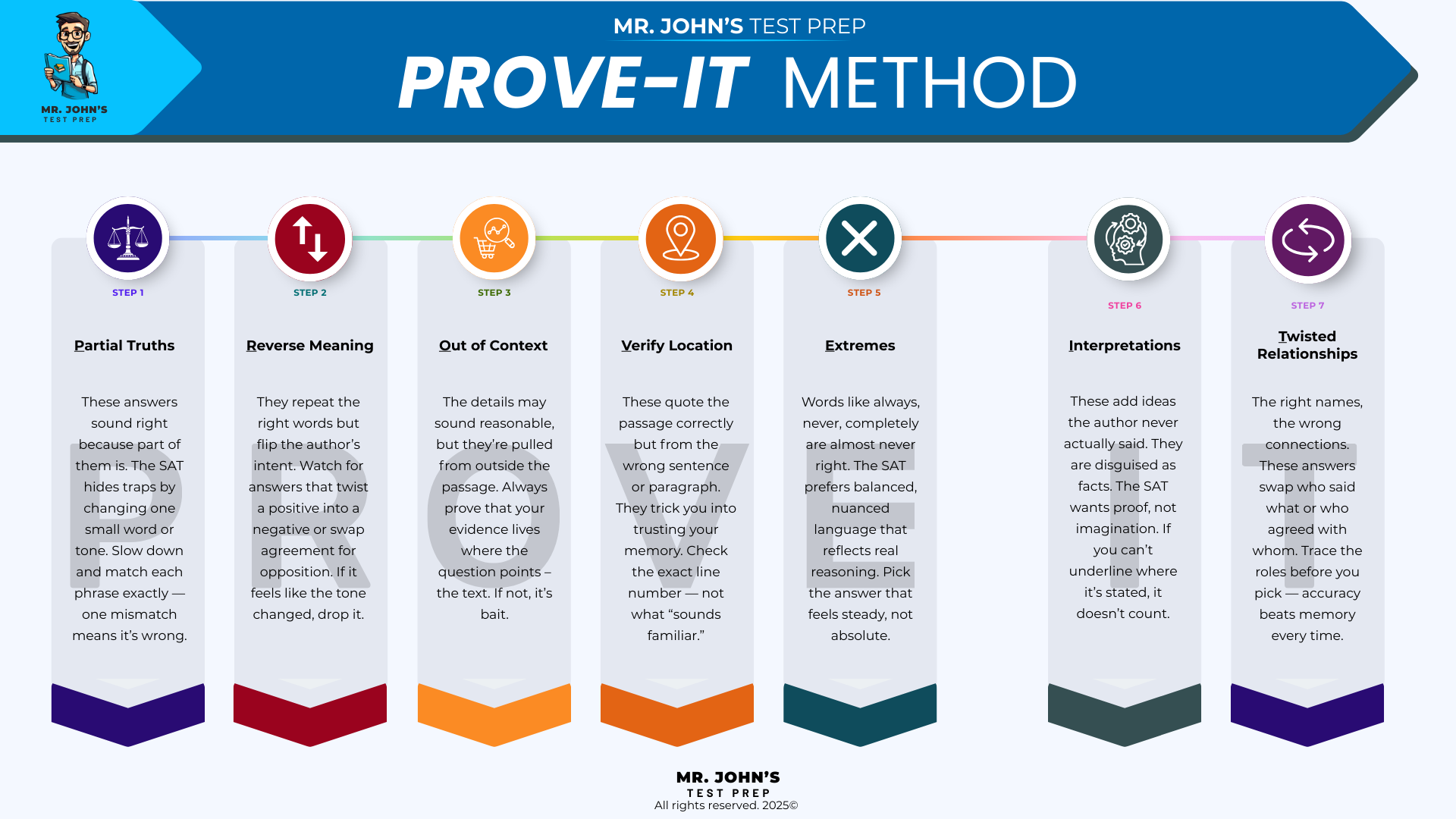
By this point, many of my students start using the PROVE-IT method — a way to test your reasoning before locking in an answer. You don’t need to know every detail here, but it’s about slowing your thinking just enough to stay confident instead of second-guessing yourself.
4. Focus on Mastery, Not Perfection
Breaking through a plateau isn’t about chasing a perfect score. It’s about mastering your process. Once your approach feels consistent and repeatable, the numbers take care of themselves.
Reset Before You Reach Out
Sometimes the reason your score won’t move isn’t your skill — it’s your stamina. When you’ve been pushing for weeks, your brain stops absorbing new information. Fatigue hides improvement.
The best students I’ve coached don’t study endlessly; they rest strategically. They step back for a day or two, reset, and then review their last test with fresh eyes. A clear mind catches what a tired one misses.
Sometimes the biggest progress happens right after you stop forcing it.
But if you’ve taken that break, done the work, and still feel stuck, it’s time for perspective. Sometimes you’re too close to see what’s holding you back. That’s where coaching helps.
When I work one-on-one with students, we use RAISE, ISEE, and the PROVE-IT method to uncover blind spots and rebuild confidence. Small adjustments in pacing, timing, or mindset can move a plateau faster than months of solo practice.
If you’re ready to work through your plateau, visit mrjohntestprep.com and start with the Official SAT Vocab Quizzes or Word Stacks challenges. They’ll help you sharpen focus, build reasoning strength, and start moving past the score that’s been holding you in place.
Frequently Asked Questions about SAT Plateau
1. Why is my SAT score not improving even though I’m studying?
It usually means you’ve hit a plateau. Your easy gains are done, and your progress now depends on refining how you think through questions, not how much you study. Try reviewing your mistakes to spot patterns instead of repeating the same practice. Look for gaps in your knowledge based on the SATs domain/topic/skill taxonomy.
2. How long does an SAT plateau last?
It depends on how fast you identify what’s causing it. With the right focus and feedback, most students start seeing score jumps again within a few weeks.
3. What’s the best way to get past an SAT plateau?
Step back, rest, and review your old tests with fresh eyes. Mr. John Test Prep teaches methods like ISEE and RAISE that help you turn your mistakes into progress.
4. Does taking more practice tests help break a plateau?
Not always. Taking more tests without analyzing them can make the problem worse. Focus on quality review over quantity.
5. How do I know if I need a tutor for the SAT?
If you’ve been stuck at the same score after multiple tries, it’s time for outside perspective. Working with Mr. John Test Prep can help uncover blind spots and fix habits that self-study can’t.
6. What should I do when I get burned out from studying?
Take a short break and come back with a clear mind. Mr. John Test Prep recommends strategic rest and quick focus drills like Weekly Words or WordStacks to rebuild energy without losing progress.
7. Can mindset really affect my SAT score?
Absolutely. Confidence and focus make a big difference, especially under time pressure. Your mindset can be the key to breaking your plateau.